Opining the lack of type 1 people in public leadership? Federal Election. Climate change anyone?
Looking back to look forward.
In 1916, the year my father was born, we only knew of our own galaxy. Think about that for a moment…
We did not think there were any other galaxies. Consider that in just over one lifetime, we have now observed/measured two black holes colliding with the Advanced Laser Interferometer Gravitational-wave Observatory (LIGO). Gravitational waves. We have come a long way. Perhaps.
[Source: CalTech ]
Energy
Just as naively, many of the greatest minds of the earliest 20th century where adamant that producing energy from the breaking down of atoms was nothing more than “moonshine”. In fact, Sir Ernest Rutherford’s famous declaration [and centuries of ‘evidence’] was totally upended less than twenty-fours hours later by Leo Szilard when he announced the nuclear chain-reaction. He conceived the nuclear chain reaction in 1933, patented the idea of a nuclear reactor with Enrico Fermi in 1934, and in late 1939 wrote the letter for Albert Einstein’s signature that resulted in the Manhattan Project that built the atomic bomb. The rest they say, is history.
That was completed in less time than the average student spends in school.
In the span of my father’s and my own life-times, Nikolai Kardashev (a Russian Physicist) posited in 1964 what is now known as the “Kardashev Scale”. Kardashev was looking for signs of extraterrestrial life within cosmic signals and developed a scale of energy/power usage.
It has 3 base classes, each with an energy disposal level: Type I (10¹⁶W), Type II (10²⁶W), and Type III (10³⁶W).
A Type I civilization—also called a planetary civilization—can use and store all of the energy available on its planet.
A Type II civilization—also called a stellar civilization—can harness the total energy of its planet’s parent star (the most popular hypothetical concept being the Dyson sphere—a device which would encompass the entire star and transfer its energy to the planet(s)).
A Type III civilization—also called a galactic civilization—can control energy on the scale of its entire host galaxy.
The scale is hypothetical, and regards energy consumption on a cosmic scale.
The salient point here is to note that the human race and planet earth is NOT on this scale.
Not yet, ever?
Even more puzzling is the growing awareness of the silence/lack of any obvious other example of a Type 1 or greater civilization anywhere in the observable universe.
We understand the universe to be 13.8 billion years old.
This is the Fermi Paradox, or more colloquially understood as “where is everybody?”.
The Fermi paradox is named after the aforementioned physicist Enrico Fermi and refers to the apparent contradiction between the lack of evidence for and various high probability estimates of the existence of extraterrestrial civilizations elsewhere in just the (our) Milky Way galaxy.
The basic points of the argument, made by physicists Enrico Fermi (1901–1954) and Michael H. Hart (born 1932), are:
There are billions of stars in the galaxy that are similar to the Sun, and many of these stars are billions of years older than the Solar system.
With high probability, some of these stars have Earth-like planets, and if the Earth is typical, some may have already developed intelligent life.
Even at the slow pace of currently envisioned interstellar travel, the Milky Way galaxy could be completely traversed in a few million years.
According to this line of reasoning, the Earth should have already been visited by extraterrestrial aliens, or at least their probes.
This may sound far-fetched, yet the law of big numbers is compelling. Many have described this as the challenge of all intelligent life. At some point, life “cracks the atom” and then faces “the great filter”.
The Great Filter
This probability threshold, which could lie behind us (in our past) or in front of us (in our future), might work as a barrier to the evolution of intelligent life, or as a high probability of self-destruction. The main counter-intuitive conclusion of this observation is that the easier it was for life to evolve to our stage, the bleaker our future chances probably are.
The idea was first proposed in an online essay titled “The Great Filter – Are We Almost Past It?“, written by economist Robin Hanson. The first version was written in August 1996 and the article was last updated on September 15, 1998.
Using extinct civilizations such as Easter Island as models, a study conducted in 2018 posited that climate change induced by “energy intensive” civilizations may prevent sustainability within such civilizations, thus explaining the lack of evidence for intelligent extraterrestrial life.
Whatever the case, the notion of the anthropocene is increasingly valid and the national and global debates over energy sources, current and future, have starkly different trajectories for both the short term quality of life of millions and frankly, the sustainability of human civilization.
With no evidence of intelligent life other than ourselves, it appears that the process of starting with a star and ending with “advanced explosive lasting life” must be unlikely. This implies that at least one step in this process must be improbable. Hanson’s list, while incomplete, describes the following nine steps in an “evolutionary path” that results in the colonization of the observable universe:
A sobering thought [understatement] when considering energy and climate policies that will set trajectories for life-times to come.
It would be useful to have a few more Type 1 People in public life don’t you think?
Michio Kaku is an American theoretical physicist and as early as 1991, was expressing as similar concern.
Michio Kaku
Carl Sagan – The Demon Haunted World
I couldn’t send such a diatribe without a reference to the venerable (and increasingly prescient) Carl.
“Science is more than a body of knowledge; it is a way of thinking. I have a foreboding of an America in my children’s or grandchildren’s time—when the United States is a service and information economy; when nearly all the key manufacturing industries have slipped away to other countries; when awesome technological powers are in the hands of a very few, and no one representing the public interest can even grasp the issues; when the people have lost the ability to set their own agendas or knowledgeably question those in authority; when, clutching our crystals and nervously consulting our horoscopes, our critical faculties in decline, unable to distinguish between what feels good and what’s true, we slide, almost without noticing, back into superstition and darkness.”
In an age of “likes”, “friends”, virtual business, “disruption” and automation, it appears there is still room for the genuine steel-bending industrialist with a bold vision, committed to building real assets with genuine ingenuity and innovation.
Perhaps best defined by events that occurred ten years ago today.
A single decade, a BILLION + units, 13 models, 395 sold every minute, 101 million users in the US alone,
Still hard to fathom…
Steve Jobs and Apple launched the iPhone on January 9th 2007.
[ Steve Jobs iPhone Launch January 9th 207 ]As Apple says:
At Macworld 2007 in San Francisco, Steve Jobs introduced the world to iPhone as three products in one — “a widescreen iPod with touch controls, a revolutionary mobile phone and a breakthrough internet communications device.” In the ten years since, iPhone has enriched the lives of people around the world with over one billion units sold. It quickly grew into a revolutionary platform for hardware, software and services integration, and inspired new products, including iPad and Apple Watch, along with millions of apps that have become essential to people’s daily lives.
The term “innovation” has been embedded in Australian public policy discussions for many decades, in many domains of activity, from Education, to Science, Health, Manufacturing, Agriculture and yes, even Mining.
We hear this term a lot… Unfortunately, we seem to conflate genuine innovation, [which in my view requires the interdisciplinary approach of many groups, supplemented by visionary legislative and regulatory frameworks encouraging and supporting creative and entrepreneurial actors] with what can only be described as risk-averse, managerial, cost-saving approaches to existing activity.
A structural bias against the “new”. Barry Jones opined years ago about the rise of the managerial-class in Politics…
Hardly the future focussed, innovative and visionary view that could unlock generations of science, technology, engineering and mathematics graduates [S.T.E.M ]. Not to mention the entrepreneurial opportunities for new materials, systems and products.
Meanwhile…
Blue Origin
Blue Origin [ @blueorigin ] is an American privately-funded aerospace developer [yes, the other one…] and manufacturer set up by Amazon.com founder Jeff Bezos [ @JeffBezos ] .
The company is developing technologies to enable private human access to space with the goal of dramatically lower cost and increased reliability. It is employing an incremental approach from suborbital to orbital flight, with each developmental step building on its prior work. [Read the Australian Senate Committee Report on their view of sub-orbital and orbital opportunities]
Just last week, January 22nd 2016, they completed the SECOND launch and landing of their re-useable system.
This is what innovation looks like in the West Texas desert. Stunning achievements.
It is important to consider the Latitude and Longitude of the Blue Origin Launch site 31.422927°N 104.757152°W.
Australia
Consider the same LATITUDE line in Australia? 31.5 degrees south. A line that dissects a point just north of Perth on our West coast and runs through the lower section of our continent, [funnily enough, right through the WOOMERA rocket range, dissecting a point on our East coast, just south of Port Macquarie.
Consider for a moment the strategic asset that open-space, serviced by existing infrastructure provides for such “orbital industries”. It is the same strategic asset that gives us our Aviation training industry [among others]. Consider our existing settlements, roads, rail lines, cities and populations along this line.
Consider our world-class Higher Education sector.
Consider the input-cost of “open space” and the potential value-add of a square kilometre of that open space, compared to mining, tourism, and space-flight, just to name a few.
Consider Australia’s current employment trends and when and how the “new industries” we so often discuss will actually eventuate?
The upcoming Australian Federal Budget in May of this year, will once again struggle with the challenges of “getting the balance right”. Trimming percentage points, raising a tax here, offsetting with incentives there, worrying about reduced receipts so “managing” the budget by cutting costs…
All the while, “orbital industries” don’t have an Australian flag…
There still comes a time when we need to consider the calculus of historically contracting “core-industries”, leaving the country with between four to five MORE people looking for work than the number of vacant positions… Yes, the State of Victoria alone has more registered unemployed people than the number of Job Vacancies advertised nationally!
New jobs? Real jobs? Perhaps we need to look to the sky…
The nature of true innovation is such that any unique activity is at once, both ignored as irrelevant and recognised [by some] as the future…
The difficult part is knowing which one…
We know what we are, but know not what we may be.
William Shakespeare
Given current policy debates regarding “industries of the future” and the need to be “agile” and “innovative”, it is instructive to consider our own cognitive biases when it comes to change, reform and innovation. Consider public policy debates of energy futures and global warming.
Thanks to The Atlantic for highlighting the work of the tech website BGR when they uneartheda comment thread from 2007 that originally appeared on the website Engadget, and was preserved by the Internet Archive.
The conversation is focused on the brand new iPhone, which had just been unveiled.
For those of you that can remember rotary dial phones, communication prior to the internet and those that euphemistically consider themselves well-read [at least when there were identifiable canons that one could digest in a life-time ] the prospect of the technological and behavioural change that occurred on the release of the “iPhone” is nothing short of profound.
[Rotary Dial Phone]Just eight years ago. The concept of “generational change” has perhaps been compressed to “decadal” or something even more finely temporal.
How we react to change, how we identify the new through the frameworks of the past are increasingly challenges of modern, highly technical societies.
Consider these humorous, prophetic and simply wrong reviews of the newly unveiled iPhone and consider our current notions of “innovation”.
“Apparently none of you guys realize how bad of an idea a touch-screen is on a phone. I foresee some pretty obvious and pretty major problems here. I’ll be keeping my Samsung A707, thanks… Color me massively disappointed.”
“Touch screen buttons? BAD idea. This thing will never work.”
“I say get on the train, or get run over by it.”
“No freaking way, Apple! It’s over!”
“Well, it beats the hell outta my Nokia 6030”
“Steve…where is my FM radio?”
“OMG, its the Newton reborn!”
“no qwerty keyboard? ojhsdodsagfadhjldgs!!”
“This looks like a disgusting bastard child of iPod/Cellphone/PDA. Yes it’s shiny, but I’m sure it won’t be so shiny once you touch it.”
“5 hour battery life!!!!!!!!!!!!!!!!!!!! ARE YOU KIDDING ME THIS IS A JOKE ITS A PHONE NOT A LAPTOP”
“DAMN! If you think it’s big, look at the picture with Steve holding it close up, its like a Razr! Wifi! Everything, good BYE every phone company in the world.”
“Im not impressed with the iPhone. As a PDA user and a Windows Mobile user, this thing has nothing on my phone… No thanks Apple. Make a real PDA please.”
“I mean it looks pretty but its not something i foresee being the next ipod for the phone industry…It took apple how long to develop this ONE PHONE, samsung and motorola release new phones every few months lol, and constantly innovates and gets better, im sorry but if im sending text messages i’d rather have my thumb keyboard than some weird finger tapping on a screen crap.”
“These comments remind me of the folks who thought the original iPod didn’t stand a chance.”
“Blackberry is DEAD. And so is every other poorly designed idiot phone and plastic PDA. Thank God. R.I.P. Blackberry. R.I.P. Palm. R.I.P. Treo.”
“That sound I just heard was everybody’s head exploding.”
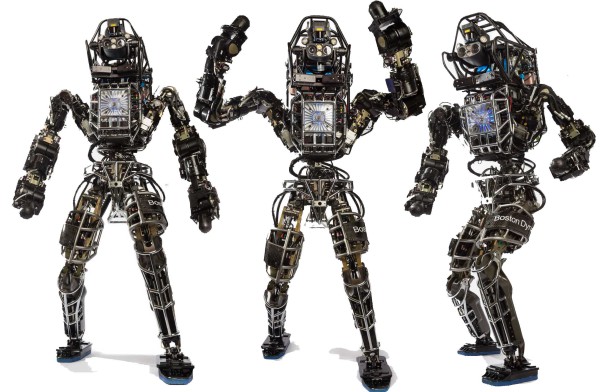
around the 1:20 mark, when a pair of Spots begin trekking up a hill. Spot Number One starts repeatedly colliding into Spot Number Two—and neither loses balance. After a few seconds and a bit of subtle push-and-shove, they straighten out and walk in parallel again, and then turn together once they reach the top of the hill.
Not quite the BORG but the advances being made are stunning.