At times like these, it’s worth considering the words of Carl Sagan.
Pale Blue Dot
Look again at that dot. That’s here. That’s home. That’s us. On it everyone you love, everyone you know, everyone you ever heard of, every human being who ever was, lived out their lives. The aggregate of our joy and suffering, thousands of confident religions, ideologies, and economic doctrines, every hunter and forager, every hero and coward, every creator and destroyer of civilization, every king and peasant, every young couple in love, every mother and father, hopeful child, inventor and explorer, every teacher of morals, every corrupt politician, every “superstar,” every “supreme leader,” every saint and sinner in the history of our species lived there–on a mote of dust suspended in a sunbeam.
The Earth is a very small stage in a vast cosmic arena. Think of the rivers of blood spilled by all those generals and emperors so that, in glory and triumph, they could become the momentary masters of a fraction of a dot. Think of the endless cruelties visited by the inhabitants of one corner of this pixel on the scarcely distinguishable inhabitants of some other corner, how frequent their misunderstandings, how eager they are to kill one another, how fervent their hatreds.
Our posturings, our imagined self-importance, the delusion that we have some privileged position in the Universe, are challenged by this point of pale light. Our planet is a lonely speck in the great enveloping cosmic dark. In our obscurity, in all this vastness, there is no hint that help will come from elsewhere to save us from ourselves.
The Earth is the only world known so far to harbor life. There is nowhere else, at least in the near future, to which our species could migrate. Visit, yes. Settle, not yet. Like it or not, for the moment the Earth is where we make our stand.
It has been said that astronomy is a humbling and character-building experience. There is perhaps no better demonstration of the folly of human conceits than this distant image of our tiny world. To me, it underscores our responsibility to deal more kindly with one another, and to preserve and cherish the pale blue dot, the only home we’ve ever known.
…To sate the lust of power; more horrid still, The foulest stain and scandal of our nature Became its boast — One Murder made a Villain: Millions a Hero. — Princes were privileg’d To kill, and numbers sanctified the crime. Ah! why will Kings forget that they are Men? And men that they are brethren? Why delight In human sacrifice? Why burst the ties Of nature, that should knit their souls together…
The Lowy Institute Interpreter has highlighted a new video from Vox giving a simple, quick and easy breakdown of Iran’s government and upcoming parliamentary elections that will be held on 26 February.
They say: Often Western media portrays Iran as just another top-down dictatorship with ‘no politics to speak of’, but there is real ideological ‘tussle’ within the Islamic Republic and its complex institutions. Iran has also been the subject of that question in the West: are Islam and democracy ‘compatible’?
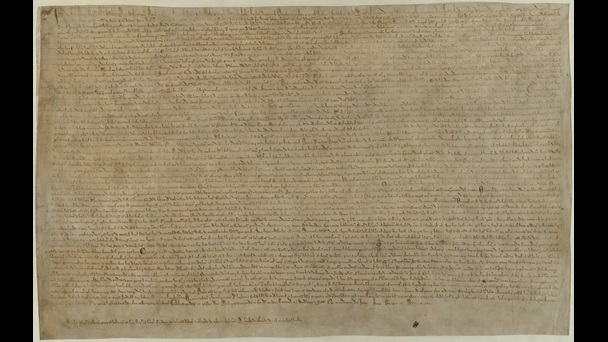
A timely reminder – The King is subject to the law.
‘to no one will we sell, to no one deny or delay right or justice’
An affirmation that authority should be subject to law arising from the community itself, Magna Carta is a foundation stone of constitutional and parliamentary government.
Let’s hope the Foundation for Liberty is correct when they say:
800 years on, Magna Carta’s best days lie ahead. As an idea of freedom, democracy and the rule of law, it is lapping against the shores of despotism.
The Mid-year Economic and Fiscal Outlook (MYEFO) has been published today by The Honourable J. B. Hockey MP Treasurer of the Commonwealth of Australia and Senator the Honourable Mathias Cormann Minister for Finance of the Commonwealth of Australia
The Charter of Budget Honesty Act 1998 requires the Treasurer to publicly release and table a Mid-year Economic and Fiscal Outlook (MYEFO) report by the end of January in each year, or within 6 months after the last budget, whichever is later.
Since the first MYEFO report in 1997-98 the Treasurer and the Minister for Finance and Deregulation have issued the report as a joint statement.
The purpose of the MYEFO report is to provide updated information to allow the assessment of the Government’s fiscal performance against the fiscal strategy set out in the current Budget Papers (Budget Paper No. 1).
Overview:
The key summary position of the document states:
The budget position has deteriorated significantly since the 2013 Pre-Election Economic and Fiscal Outlook (PEFO). Budget deficits totalling $123 billion are now expected across the forward estimates, with a $47 billion deficit expected in 2013-14 — 3.0 per cent of Gross Domestic Product (GDP). Without policy change and taking no remedial action, budget deficits would be projected in each and every year to 2023-24.
The major economic parameters suggest a softening and slowing of domestic prices and wages and thus there is a commensurate reduction in the forecast Real GDP from 3% [ PEFO Pre-Election Economic and Fiscal Outlook ] to 2.5%
MYEFO 2013 Parameters
Education, Training & Climate
Of immediate note and direct interest to many of my readers will be the changes within the Education and Training portfolio indicated over the outer years of the budget, particularly:
Trade Training Centres — cessation
redirecting funding over six years under the Building Stronger Communities Fund ($528 million) and Trade Training Centres ($987 million) and other smaller portfolio savings, to broadly offset the cost of Students First — A fairer funding agreement for schools. The savings decisions for the Building Stronger Communities Fund and Trade Training Centres are expected to decrease cash payments by $104 million in 2013-14 ($841 million over four years);
The Government will achieve savings of $986.5 million over five years (including $375.8 million in 2017-18 and $298.0 million in 2018-19) by ceasing the Trade Training Centres programme.
Australian Curriculum, Assessment and Reporting Authority — reduction in funding
The Government will refocus the Australian Curriculum, Assessment and Reporting Authority’s (ACARA) activities to ensure it is developing the highest possible standard curriculum and direct its resources to developing benchmarking processes so Australia can compare its curriculum against the world’s best. As part of this refocussing, ACARA’s funding will be reduced by $20.0 million over four years.
Department of Climate Change
The Government will achieve savings of $45.0 million over four years (and $12.8 million per annum from 2017-18) by reducing the functions of the former Department of Climate Change and Energy Efficiency that were transferred to the Department of the Environment, the Clean Energy Regulator, the Department of Industry and the Department of Foreign Affairs and Trade.
Confessions of a “non-facebooker”.. or.. why the cost of admission is too steep!
If you’re not paying for something, you’re not the customer; you’re the product being sold.
– Andrew Lewis
My colleague stood genuinely “stunned” for a few seconds while they tried to process the fact I was not on Facebook, had never used Facebook and clearly had no plans to ever use Facebook…
My colleague stated the obvious, one more time, just to be sure.
YOU, of all people, are NOT on Facebook? I don’t get it?
Of course, the simplest answer was that I have no friends or social network. Whilst funny, not entirely true. The realisation soon dawned on my colleague that I chose not to be “on” Facebook. This was surprising to both of us. Certainly, everyone I know uses Facebook [almost everyone I know].
Apologies to the python crew…
Having reached adulthood, graduated from school, worked a little, graduated from university,travelled a lot, all without the existence of modern computers or “the internet” and then having spent my entire working life [since] immersed in the connectivity and collaborative space that ubiqutous connectivity continues to bring to our lives, gives me a reasonable “pre and post internet” perspective. I can see the irony.
I advise individuals and organisations [at times] on their use and implementation of online technologies and the implications for their lives and business. I thought it useful to make some simple observations from someone who finds themselves awkwardly between the “builder” generation of my parents [who experienced the great depression and wars, thus suspicious of the transitory nature of “the good times” and always fiercely self-reliant and self-contained] and the confident, ambitious and achievement-oriented “Gen-Y / Millennials” or whatever ridiculous catch-all stereotype we try to use to define individual characteristics of whole generations. A generation that has only known the internet and accepts readily, and often without question, a very different definition of privacy and personal expression than I.
Of course I accept some of this as simply the age-old “generation gap”. We do things differently, “my generation” does not “get it” and “their” generation cannot view their own actions through “our” lens of experience.
In fact Scott McNealy, CEO of Sun Microsystems in 1999, said, quite bluntly:
You have zero privacy anyway. Get over it
As the original author of the piece quoting McNealy said, he is right about the first part, but not about the second part.
Given we have progressed over a decade since that statement was made, I see much in the structure and ownership of data that should be carefully considered by individuals and organisations alike.
Unfeted aggregation of the minutae of 100’s of millions of people lives, as individual bits and bytes of data may not seem relevant, but cloud-based aggregation of such data [ and the subsequent corporatised use/ownership of that data] is driving deeper in to the daily lives, spending patterns, tracking patterns and “thinking patterns” of users. All this to drive advertising and other “new-media” business models has an uncanny resemblance to the “big-blue” concerns of the 60’s and 70’s.
Ironically, the rise of the personal computer was designed to lessen the centralised “main-frame” view of connectivity and place greater granular control back in to the hands of the users, avoiding the very silos that it appears millions and millions and millions and millions of people are blissfully rushing headlong towards.
We have seen in the most recent events around “sub-prime” financing, the unethical and in many cases almost inexplicable practices of financial institutions destroying any notion of credibility with lending practices that cease to be recognised as anything that even approximates what I would understand to be responsible or prudent business practice. The global financial crisis of 2009 and beyond has heralded our first glimpse of post-modern corporations that are too big to fail and pose risks on society in ways that we are only beginning to understand.
We are also witnessing a curious and at times breathless disregard for what I used to understand to be an individual’s consent to the access, use or distribution of their personal information.
However, I think that this may be a concern that many (perhaps a majority) of those my own age and certainly those younger than me, simply do not share, or for that matter, even consider to be an issue.
In an age when personal images , deep thoughts on religion or sexual orientation, political affiliations, the display of open biases and hatred and even the publication of real-time location data [pleaserobme.com] are simply bytes that get added to public spaces such as Facebook, Foursquare or twitter, I come to realize that whatever demographic and generational train this is, it has already left the station without me…
To say the least… To have a third-party possess and potentially manipulate, share or on-sell such information is a legal and ethical mine-field.
When we combine the almost universal use of Facebook or similar services, particularly on mobile devices that combine access to a unique device identifier [UDID] and have geo-location capabilities, we have the combined power of third-party [and even further remotes entities] being able to correlate UDID to a real-world individual, effectively in real-time.
Such trust in third-parties [and others] is not something I share with [apparently] the vast majority of the populace. When we consider image services, social networks, business messaging services, cloud storage and mobile data products linked to handsets, we see the move that began in the 70’s, away from the “main-frame” to the relative safety and “ownership/control” of the user and their desktop, has begun the inevitable march back in to the network or “cloud”.
The cost and extent of such infrastructure was unimaginable in the 70’s or 80’s or 90’s. Today, the cost for the average user to access all the wonderful services and products available within such a network, is a mere pittance in monetary terms.
The difference this time is that the “cost of admission” is not monetary, rather it is personal. Personal information, personal practices, routines, habits, views and preferences. All monitored and aggregated. In many cases, by [in the old language] minors. Children or minors, does not appear to be a concept that the digital age understands nor really makes provision for. Certainly miners of data is understood, but not so data of minors.
Of most concern to me is that this “cost-of-admission” is almost ubiquitous and that the use, control or transfer of so much information about individuals is opaque at best.
This has serious ramifications for governing boards and individuals alike as increasing details of employees, customers, financial transactions, location and related habits are stored and shared online in ways individuals cannot easily or readily comprehend nor in most cases, discover or retrieve.
When we consider the ethical and moral challenges of even the smallest issues to do with “accidental” use of an individual’s or organisation’s contact lists [of which we see almost daily on our own email!] and compare this to the regulatory, legal and ethical challenges being debated during the so-called “News of the World Hacking Scandal” , we come to realise that notions of privacy, identity and the right to determine what information an individual considers “personal” or “public” is still very fluid and highly complex.
Even as I have been writing this over the last week, the debate over the right of prospective employers requiring password access to applicant‘s online networks adds further confusion to the space, even soliciting response from Facebook’s Chief of Privacy!!
As Dave Winer cautions, the evidence that ethics are not as present in Silicon Valley boardrooms as we would like, is self-evident.
It is still unclear as to whether such laws are designed to protect individuals from corporate misuse or to protect existing corporate markets and trade practices from disruptive technologies.
Perhaps most sobering is Alexis Madrigal’s recent article in The Atlantic – I’m Being Followed: How Google—and 104 Other Companies—Are Tracking Me on the Web..
In this she points out that the simple act of loading her morning news web site produced data thats was sent to ten different tracking and monitoring sites. In all she has found 104 other companies tracking her on the web.
[Edit April 2012 – In a very telling development, MacWorld highlights that
The makers of the mobile app Girls Around Me came under fire this past week for helping men to “stalk” unsuspecting women, but the incident also reveals how much we still have to learn about what social networks reveal about us….
Food for thought….
As an aside, there is a handy little tool called Collusion that will visualise your own “footprints” around the web.. Have a look here.