
Tag: Global Economy

  • Times like these…

    Times like these…

    At times like these, it’s worth considering the words of Carl Sagan.

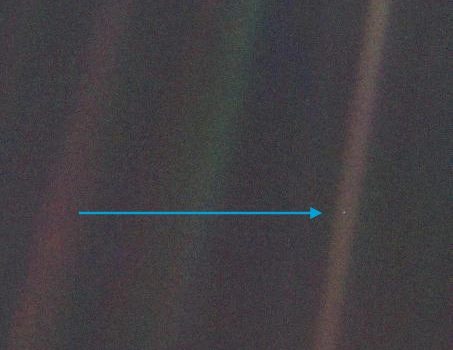
    Pale Blue Dot

    Look again at that dot. That’s here. That’s home. That’s us. On it everyone you love, everyone you know, everyone you ever heard of, every human being who ever was, lived out their lives. The aggregate of our joy and suffering, thousands of confident religions, ideologies, and economic doctrines, every hunter and forager, every hero and coward, every creator and destroyer of civilization, every king and peasant, every young couple in love, every mother and father, hopeful child, inventor and explorer, every teacher of morals, every corrupt politician, every “superstar,” every “supreme leader,” every saint and sinner in the history of our species lived there–on a mote of dust suspended in a sunbeam.

    The Earth is a very small stage in a vast cosmic arena. Think of the rivers of blood spilled by all those generals and emperors so that, in glory and triumph, they could become the momentary masters of a fraction of a dot. Think of the endless cruelties visited by the inhabitants of one corner of this pixel on the scarcely distinguishable inhabitants of some other corner, how frequent their misunderstandings, how eager they are to kill one another, how fervent their hatreds.

    Our posturings, our imagined self-importance, the delusion that we have some privileged position in the Universe, are challenged by this point of pale light. Our planet is a lonely speck in the great enveloping cosmic dark. In our obscurity, in all this vastness, there is no hint that help will come from elsewhere to save us from ourselves.

    The Earth is the only world known so far to harbor life. There is nowhere else, at least in the near future, to which our species could migrate. Visit, yes. Settle, not yet. Like it or not, for the moment the Earth is where we make our stand.

    It has been said that astronomy is a humbling and character-building experience. There is perhaps no better demonstration of the folly of human conceits than this distant image of our tiny world. To me, it underscores our responsibility to deal more kindly with one another, and to preserve and cherish the pale blue dot, the only home we’ve ever known.

    Carl Sagan The Pale Blue Dot 1994

    Links

  • 50 Years on – Limits to Growth

    50 Years on – Limits to Growth

    The Club of Rome’s report from 1972 is 50 years old.

    I read it when it was first published… A sobering and influential read then.

    What’s changed in that time?

    World Model Standard Run as shown in The Limits to Growth

    The Last Call?

  • Hans. How not to be ignorant

    Hans. How not to be ignorant

    At a time when it appears revealed truths, beliefs and opinions are increasingly privileged in public and political debate,there was always Hans…

    Vale, Hans Rosling

    [ted id=2090]

    Links


  • The world’s Income

    The world’s Income

    The team at HowMuch.net  continue their excellent work.

    The full article can be found here.

    The Global Finance Magazine recently released an article comparing countries by income across the world for 2015, sourcing data from the World Bank. Gross National Income (GNI) per capita is the final income earned by a country’s residents divided by the total population.

    Countries are divided into 4 different groups:

    • Group 1 – Low income: $1,045 or less

    • Group 2 – Lower middle income: $1,046 to $4,125

    • Group 3 – Upper middle income: $4,126 to $12,745

    • Group 4 – High income: $12,746 or more

    Based on the data of 204 countries, below is a breakdown of the number of countries that fall within each of the 4 income groups listed above.

    • Group 1 – Low income: 17%

    • Group 2 – Lower middle income: 25%

    • Group 3 – Upper middle income: 26%

    • Group 4 – High income: 32%


    Oceania, Asia and Africa

    Oceania

    Asia

    Africa


    Source:

  • Technology, Talent, Tolerance

    Australia tops Global Creativity Index

  • R > G

    Capital
    Capital in the 21st Century

    “Capital in the Twenty-First Century”, written by the French economist Thomas Piketty

    I am yet to finish reading this, but earlier this year, the economist said:

    “Capital” is built on more than a decade of research by Mr Piketty and a handful of other economists, detailing historical changes in the concentration of income and wealth. This pile of data allows Mr Piketty to sketch out the evolution of inequality since the beginning of the industrial revolution. In the 18th and 19th centuries western European society was highly unequal. Private wealth dwarfed national income and was concentrated in the hands of the rich families who sat atop a relatively rigid class structure. This system persisted even as industrialisation slowly contributed to rising wages for workers. Only the chaos of the first and second world wars and the Depression disrupted this pattern. High taxes, inflation, bankruptcies, and the growth of sprawling welfare states caused wealth to shrink dramatically, and ushered in a period in which both income and wealth were distributed in relatively egalitarian fashion. But the shocks of the early 20th century have faded and wealth is now reasserting itself. On many measures, Mr Piketty reckons, the importance of wealth in modern economies is approaching levels last seen before the first world war.

    From this history, Mr Piketty derives a grand theory of capital and inequality. As a general rule wealth grows faster than economic output, he explains, a concept he captures in the expression r > g (where r is the rate of return to wealth and g is the economic growth rate). Other things being equal, faster economic growth will diminish the importance of wealth in a society, whereas slower growth will increase it (and demographic change that slows global growth will make capital more dominant). But there are no natural forces pushing against the steady concentration of wealth. Only a burst of rapid growth (from technological progress or rising population) or government intervention can be counted on to keep economies from returning to the “patrimonial capitalism” that worried Karl Marx. Mr Piketty closes the book by recommending that governments step in now, by adopting a global tax on wealth, to prevent soaring inequality contributing to economic or political instability down the road.

    The book has unsurprisingly attracted plenty of criticism. Some wonder whether Mr Piketty is right to think the future will look like the past. Theory argues that it should become ever harder to earn a good return on wealth the more there is of it. And today’s super-rich mostly come by their wealth through work, rather than via inheritance. Others argue that Mr Piketty’s policy recommendations are more ideologically than economically driven and could do more harm than good. But many of the sceptics nonetheless have kind words for the book’s contributions, in terms of data and analysis. Whether or not Mr Piketty succeeds in changing policy, he will have influenced the way thousands of readers and plenty of economists think about these issues.

    – See more at The Economist

  • Forecasters Forecasting Forecasts

    Tim Harford wrote a piece in ft.com earlier this year, documenting the [not-so-surprising] inaccuracy and just-plain “wrongfulness” of economic forecaster[s] [ing]……

    In the 2001 issue of the International Journal of Forecasting, an economist from the International Monetary Fund, Prakash Loungani, published a survey of the accuracy of economic forecasts throughout the 1990s.

    The record of failure to predict recessions is virtually unblemished.


    He reached two conclusions.

    • The first was that forecasts are all much the same. There was little to choose between those produced by the IMF and the World Bank, and those from private sector forecasters.
    • The second conclusion was that the predictive record of economists was terrible. Loungani wrote: “The record of failure to predict recessions is virtually unblemished.”

    The authors returned to the topic during/after the “Global Financial Crisis”.

    Links


  • Limits to Growth …was right…

    Limits to Growth …was right…

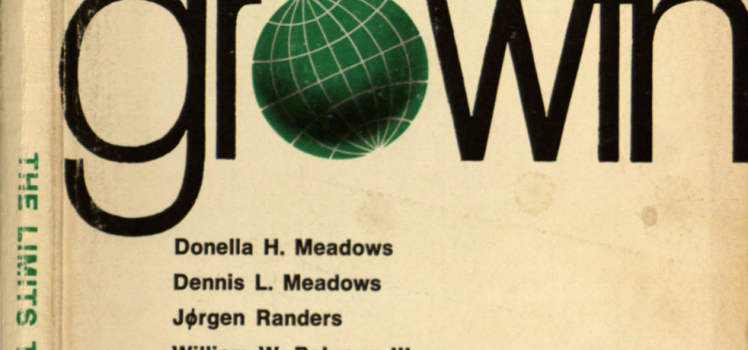
    Limits of Growth Cover
    [Source: Club of Rome]
    LTG
    Source: The Guardian

    I was a school student when this first Club of Rome Report was widely heralded.

    I was in University studying Geography, History, Literature and Politics when I looked closely at its research and findings.

    I was teaching when the “20 year old” report was critiqued as flawed and plain wrong.

    As Limits to Growth concluded in 1972:


    If the present growth trends in world population, industrialisation, pollution, food production, and resource depletion continue unchanged, the limits to growth on this planet will be reached sometime within the next one hundred years. The most probable result will be a rather sudden and uncontrollable decline in both population and industrial capacity.

    Four decades after the book was published, Limit to Growth’s forecasts have been vindicated by new Australian research.

    -The Guardian


    The task was very ambitious. The team tracked industrialisation, population, food, use of resources, and pollution. They modelled data up to 1970, then developed a range of scenarios out to 2100, depending on whether humanity took serious action on environmental and resource issues. If that didn’t happen, the model predicted “overshoot and collapse” – in the economy, environment and population – before 2070. This was called the “business-as-usual” scenario.

    The book’s central point, much criticised since, is that “the earth is finite” and the quest for unlimited growth in population, material goods etc would eventually lead to a crash.


    So were they right? We decided to check in with those scenarios after 40 years. Dr Graham Turner gathered data from the UN (its department of economic and social affairs, Unesco, the food and agriculture organisation, and the UN statistics yearbook). He also checked in with the US national oceanic and atmospheric administration, the BP statistical review, and elsewhere.

    That data was plotted alongside the Limits to Growth scenarios.

    The results show that the world is tracking pretty closely to the Limits to Growth “business-as-usual” scenario.

    As described below, data from the forty years or so since the LTG study was completed indicates that the world is closely tracking the BAU scenario. In the BAU, during the 20th century increasing population and demand for material wealth drives more industrial output, which grows at a faster rate than population.

    LTG
    Source: The Guardian


    Links:

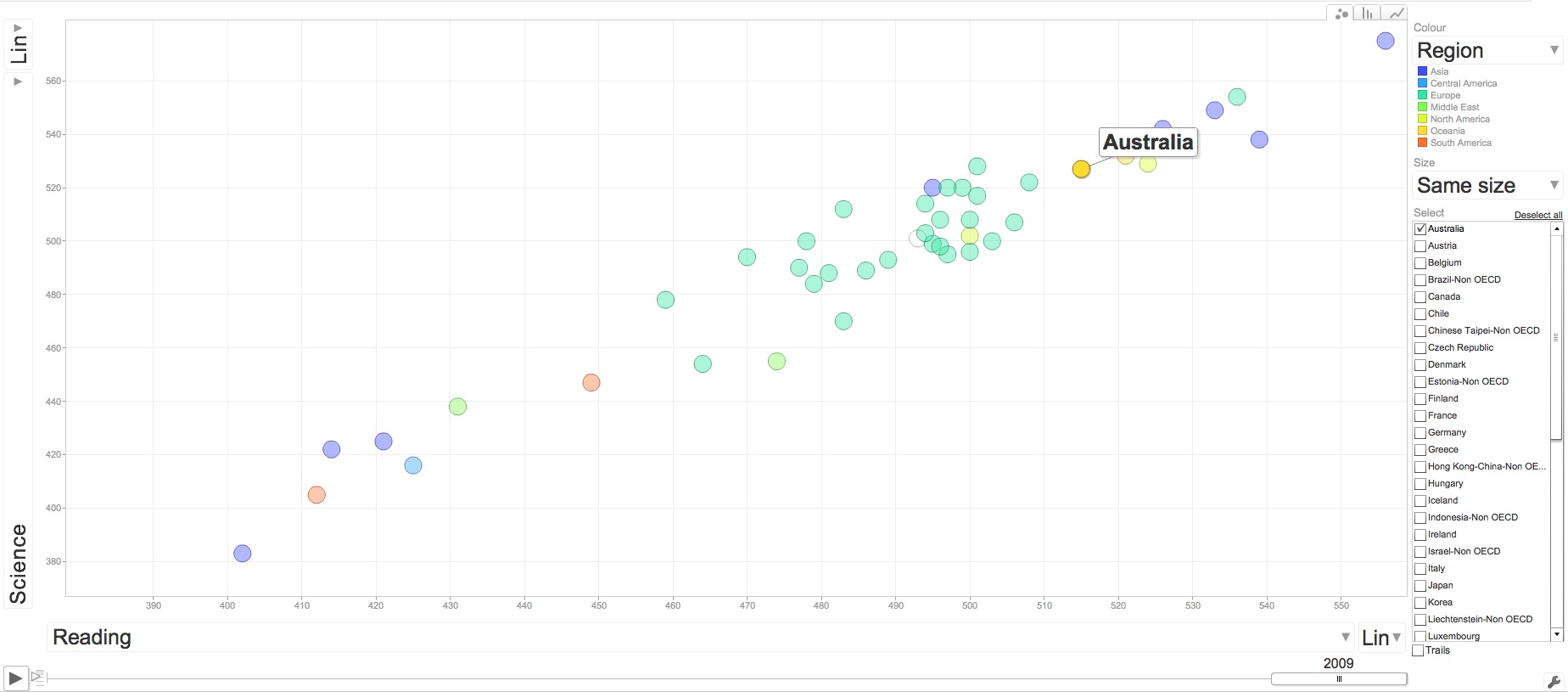
  • OECD – Australia – Going for Growth

    The OECD has published a series of country notes that assesses progress that countries have made in responding to Going for Growth policy recommendations since 2011.

    It identifies and discusses new priority areas where structural reforms are needed to lift growth across OECD and BRIICS countries. The Australian country note is below.


    Australia | OECD Free preview | Powered by Keepeek Digital Asset Management Solution