The report addresses the most up-to-date physical understanding of the climate system and climate change, bringing together the latest advances in climate science, and combining multiple lines of evidence from paleoclimate, observations, process understanding, and global and regional climate simulations.
In essence, zero net emissions by mid-century is required… [can you hear the crickets?] I await the thoughtful and reasoned, complex and nuanced responses from our elected representatives.
Limiting warming to 1.5oC is possible within the laws of chemistry and physics but doing so would require unprecedented changes,” – Jim Skea, Co-Chair of IPCC Working Group III.
and…
Human activities are currently emitting about 42bn tonnes of carbon dioxide every year, and at that rate the carbon budget – allowing us a 50-50 chance of keeping warming to 1.5C – would be exhausted within 20 years.
Even 1.5C of warming would have brutal consequences, according to the report. Poor people, in particular, would suffer as the threat of food and water shortages increase in some parts of the world.
But the report makes clear that allowing warming to reach 2C would create risks that any reasonable person would regard as deeply dangerous.
– Nicholas Stern
Consider the Spiral from 2016. What do you think has changed?
Consider the state of current general policy response to a warming planet and those that offer ‘opinion’ or ‘identity’ as a generational policy vector. We should take Hitch’s advice…
What can be asserted without proof can be dismissed without proof.
– Christopher Hitchens
In 2015 governments adopted the Paris Agreement to tackle climate change and invited the IPCC to prepare a special report in 2018 to assess the impacts and related pathways of warming of 1.5oC.
This is due on the 8th of October.
The Special Report on 1.5°C assesses three main themes:
What would be required to limit warming to 1.5°C (mitigation pathways)
The impacts of 1.5°C of warming, compared to 2oC and higher
Strengthening the global response to climate change; mitigation and adaptation options
Some food for thought on the IPCC process.
The process of preparing an IPCC report involves both scientists and government representatives.
Ninety-one authors from 40 countries have been involved in the assessment and writing of the Special Report on 1.5 degrees. Chapter teams comprise three Coordinating Lead Authors (CLAs) and a team of Lead Authors, who are responsible for developing the chapter’s content. Review Editors are respon- sible for ensuring the integrity of the review process.
A further 133 Contributing Authors added their expertise to the report.
The report has over 6,000 cited references to the scientific literature.
Forthcoming reports
The IPCC Special Report on 1.5oC is due to be released in October 2018, subject to approval. Two other special reports, Climate Change and Land, and the Ocean and Cryosphere in a Changing Climate, will be published in 2019, as will a refinement to the IPCC’s 2006 Guidelines on National Greenhouse Gas Inventories. The three Working Group contributions to the Sixth Assessment Report will be published in 2021, with a Synthesis Report in 2022.
It will be an interesting exercise to observe global, national and state media.
Leadership, Innovation, Ingenuity, Diplomacy Fore-sight and Vision.
When is the last time you saw words like that in our daily headlines?
Simply the single-biggest policy issue facing us all.
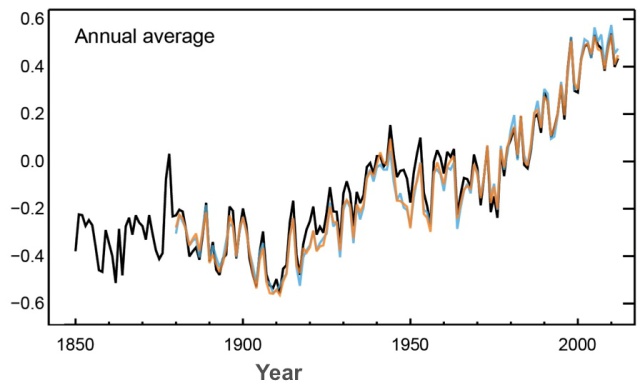
Globally Averaged COMBINED Land & Ocean surface temperatures
The United Nations Intergovernmental Panel on Climate Change (IPCC) has released its synthesis report, a summary of its last three reports.
It warns greenhouse gas levels are at the highest they have been in 800,000 years, with recent increases mostly due to the burning of fossil fuels.
The three key points for policy makers: {my emphasis]
Human influence on the climate system is clear, and recent anthropogenic emissions of greenhouse gases are the highest in history. Recent climate changes have had widespread impacts on human and natural systems.
Warming of the climate system is unequivocal, and since the 1950s, many of the observed changes are unprecedented over decades to millennia. The atmosphere and ocean have warmed, the amounts of snow and ice have diminished, and sea level has risen.
Anthropogenic greenhouse gas emissions have increased since the pre-industrial era, driven largely by economic and population growth, and are now higher than ever. This has led to atmospheric concentrations of carbon dioxide, methane and nitrous oxide that are unprecedented in at least the last 800,000 years. Their effects, together with those of other anthropogenic drivers, have been detected throughout the climate system and are extremely likely to have been the dominant cause of the observed warming since the mid-20th century.
The Synthesis Report confirms that climate change is being registered around the world and warming of the climate system is unequivocal. Since the 1950s many of the observed changes are unprecedented over decades to millennia. Thomas Stocker, Co-Chair of IPCC Working Group said:
“Our assessment finds that the atmosphere and oceans have warmed, the amount of snow and ice has diminished, sea level has risen and the concentration of carbon dioxide has increased to a level unprecedented in at least the last 800,000 years,”
The report expresses with greater certainty than in previous assessments the fact that emissions of greenhouse gases and other anthropogenic drivers have been the dominant cause of observed warming since the mid-20th century.
The Kicker….
3.2 Without additional mitigation efforts beyond those in place today, and even with adaptation, warming by the end of the 21st century will lead to high to very high risk of severe, widespread, and irreversible impacts globally (high confidence). Mitigation involves some level of co-benefits and of risks due to adverse side-effects, but these risks do not involve the same possibility of severe, widespread, and irreversible impacts as risks from climate change, increasing the benefits from near-term mitigation efforts.
The first five points from the Executive Summary of IPCC’s latest regional report for Australasia:
The regional climate is changing (very high confidence).
Warming is projected to continue through the 21st century (virtually certain) along with other changes in climate.
Uncertainty in projected rainfall changes remains large for many parts of Australia and New Zealand, which creates significant challenges for adaptation.
Recent extreme climatic events show significant vulnerability of some ecosystems and many human systems to current climate variability (very high confidence), and the frequency and/or intensity of such events is projected to increase in many locations (medium to high confidence)
Without adaptation, further changes in climate, atmospheric CO2 and ocean acidity are projected to have substantial impacts on water resources, coastal ecosystems, infrastructure, health, agriculture and biodiversity (high confidence).
Abnormal Autumn
The average temperature for April 2014 was 1.11 degrees celsius above the long-term average, and continuation of abnormally warm temperatures into late May has delayed the onset of winter conditions across southern Australia. [Source: Climate Council]