
Category: The Brain

  • A Brain. A Map. Amazing.

    A Brain. A Map. Amazing.

    If you have never pondered the nature of exponential change/growth in knowledge, consider this.

    The human brain is one of the most complex structures in existence. Google, in collaboration with Harvard University, have released a browsable 1.4-petabyte reconstruction of a very small part of the human cortex.

    This is every cell and connection in a cubic millimeter of the human brain.

    Google Brain Map
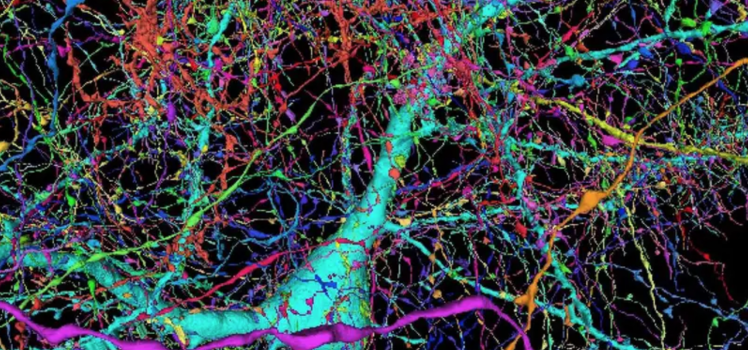
    Petabyte connectomic reconstruction of a volume of human neocortex. Left: Small subvolume of the dataset. Right: A subgraph of 5000 neurons and excitatory (green) and inhibitory (red) connections in the dataset. The full graph (connectome) would be far too dense to visualize.

    The volume spans all six cortical layers.

    The map includes 50,000 cells, all rendered in three dimensions. They are joined together by hundreds of millions of spidery tendrils, forming 130 million connections called synapses. The data set measures 1.4 petabytes, roughly 700 times the storage capacity of an average modern computer.

    “A whole mouse brain is only 1000 times bigger than this, an exabyte instead of a petabyte,” says Lichtman. “It’s on a scale where we probably will be able to do that within a decade, I suspect.”

    Dr. Jeff W. Lichtman – New Scientist

    What is the Human Cortex?
    The cerebral cortex is the thin surface layer of the brain found in vertebrate animals that has evolved most recently, showing the greatest variation in size among different mammals (it is especially large in humans). Each part of the cerebral cortex is six layered (e.g., L2), with different kinds of nerve cells (e.g., spiny stellate) in each layer. The cerebral cortex plays a crucial role in most higher level cognitive functions, such as thinking, memory, planning, perception, language, and attention. Although there has been some progress in understanding the macroscopic organization of this very complicated tissue, its organization at the level of individual nerve cells and their interconnecting synapses is largely unknown. 

    According to Google, it’s the largest brain map at this level of detail to date, and it’s freely available to scientists (and anyone) online. The link is here.

    Also…

    Links

  • Stentrode

    Stentrode


    From the University of Melbourne [@UniMelb]

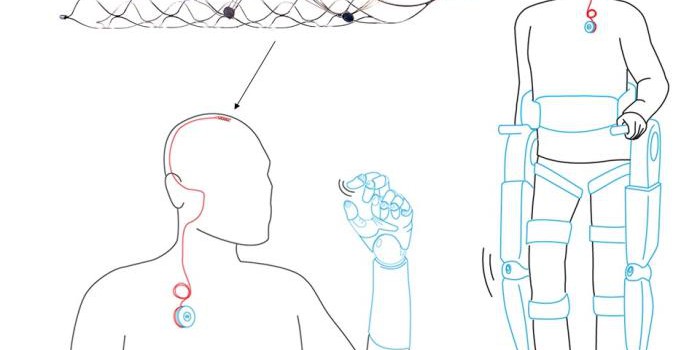
    A group of paralysed patients will soon undergo a revolutionary procedure that could allow them to walk with the power of thought. The key to returning mobility is a tiny, matchstick-sized device called a stentrode. It will be implanted into a blood vessel next to the motor cortex, the brain’s control centre – bypassing the need for complex brain surgery. From there it will pick up brain signals and allow patients to move a robotic exoskeleton attached to their limbs simply by thinking about it. This notion of wirelessly thought-controlled limbs is within reach, thanks to a collaboration of 39 brilliant minds from 16 departments across the University of Melbourne’s medicine, science, veterinary science and engineering faculties.

    Professor Terry O’Brien

    In 2017, the stent will be implanted into carefully selected paraplegic or quadriplegic patients by surgeons at the Royal Melbourne Hospital. The long road to coding will begin at the Austin Hospital’s Spinal Cord Service.

    Innovation. Your walking in it…

    This [full] article was first published on Pursuit. Read the original article.

    Links

  • The Joy of Living or Crowboarding?

    Watch this Rook closely. It is playing. It is having FUN.

    Sensory consciousness in Birds? A fascinating field of research in to the human brain, machine learning and the nature and purpose of consciousness.

    Where does consciousness come from? And does it exist in other animals?

    Nicholas Humphrey, Professor Emeritus of the London School of Economics, Darwin College Cambridge, was recently Interviewed by Robyn Williams on The Science Show.

    Links:

  • The Intelligence of Crows

    Thanks to James for this link to Betty.

    On the intelligence of crows.

    If you have read my page on Gestalt learning, you may have seen the amazing case of Betty the Crow. She features again in this longer clip, courtesy of TED.com:

    By noreply@blogger.com (James A). [Recent Reflection]