
Category: Robotics

  • and… Robots

    and… Robots

    XKCD.COM
    [Source: XKCD.Com – https://xkcd.com/1955/ ]
  • You have five seconds to comply…

    You have five seconds to comply…

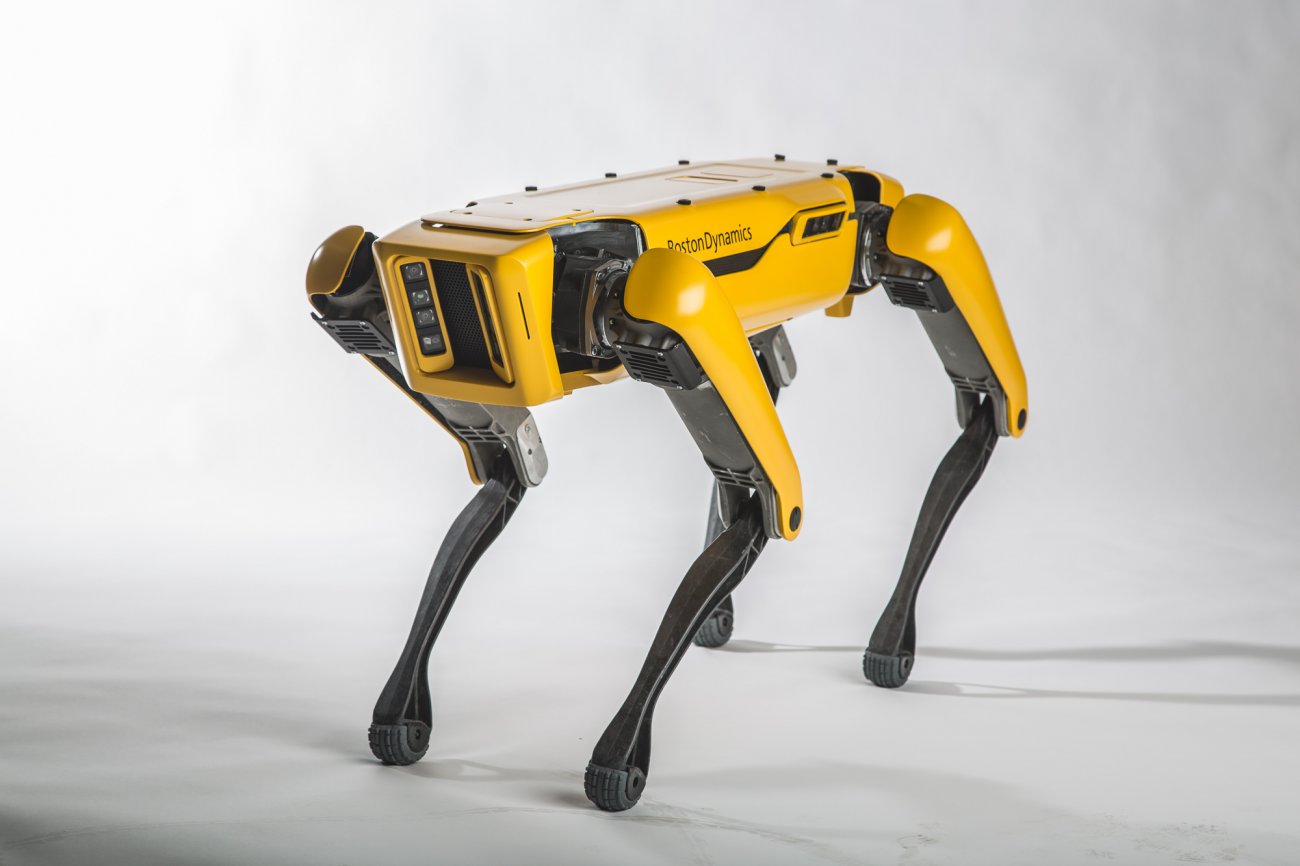
    The team at Boston Dynamics sure does have a sense of humour.  I hope.

  • Soon.

    Soon.

    The #Motobot vs Rossi @ValeYellow46

    Exponential development. Not yet, but soon.


    Links

  • Banning killer robots? Is that a thing?

    Banning killer robots? Is that a thing?

    The International Joint Conference on Artificial Intelligence is being staged in Melbourne this week. This is the main international gathering of researchers in AI. Held biennially in odd-numbered years since 1969, IJCAI is sponsored jointly by IJCAI and the national AI societie(s) of the host nation(s).

    The theme of this Year’s conference is Autonomy and AI and is intended to encourage debate and analysis of the limits and safeguards that must be established when giving AI systems more autonomy. Such limits and safe- guards must be established for AI systems to progress in way that supports a just and prosperous society. This topic will be central on some invited talks, panels, sessions.

    An open letter signed by 116 founders of companies from 26 different countries warns that the development of lethal autonomous weapons, which can kill without direct human control, is proceeding at pace and that moves to ban them – in a similar way to chemical weapons – are moving too slowly.

    A key organiser of the letter, Toby Walsh, Scientia​ Professor of Artificial Intelligence at the University of NSW in Sydney, will release it at a gathering of world leading artificial intelligence (AI) experts in Melbourne on Monday.

    CEOs from the rapidly advancing robotics and automation industry including Tesla and SpaceX boss Elon Musk have joined a University of NSW professor in calling on the UN to ban artificial intelligence-driven ‘killer robot’ autonomous weapons, before it is too late. [Source: AFR]

    Links:

  • The Butcher of the Future

    Leanna Garfield writing in BI this week outlines how the the New Zealand-based robotics company, Scott Technology Limited is developing fully-automated meat processing bots, which can extract different cuts from lamb, pig, and beef carcasses. Many meatpacking companies believe using this type of technology (rather than human workers) will make processing more efficient. Garfield points out:

    The world’s largest meat production company, JBS, is already investing in it. As NPR reported, the Brazil-based corporation bought a controlling share of Scott Technology late last year, in a deal valued at $41 million.


    At work


    Links

  • Spot – mini

    Spot – mini

    The team at BD is at it again. SpotMini is a new smaller version of the Spot robot.  SpotMini is all-electric (no hydraulics) and runs for about 90 minutes on a charge, depending on what it is doing.

    SpotMini is one of the quietest robots Boston Dynamics have ever built.

  • That’s deep!

    That’s deep!

    Seven miles deep…

    The project, which was funded by the NOAA’s Office of Ocean Exploration and Research, was designed to establish a baseline for ambient noise in the deepest part of the Pacific Ocean.

    Human-created noise has increased steadily in recent decades and getting these first recordings allows scientists in the future to determine if the noise levels are growing and how this might affect marine animals that use sound to communicate, navigate and feed, such as whales, dolphins and fish.

    Challenger Deep is a valley inside the Mariana trench, seven miles below the surface of the ocean. If Mount Everest was placed inside Challenger Deep, the mountain’s peak would still be a mile underwater.

    That’s deep…

    I am reminded of the work of esteemed American marine biologist, Roger Payne, [producer of the famed Songs of the Humpback Whale] who found in the 1960’s that the great whales of the world ‘enjoyed’ a global communication network for tens of thousand of years, gaining the benefit of a “deep sound channel in the ocean”, a combination of thermal layers and currents that allowed these whales to transmit their ‘songs’ at a wavelength of 20hz over incredible distances to communicate with whales in other oceans.

    Dr. Payne’s work was [and remains] the inspiration for many of the activities of the original Whalesong Foundation [1990]  and WhaleSongServices

    Challenger Deep

    Links:

  • The Next Generation?

    The Next Generation?

    Certainly a growing and contentious policy debate on the role and purpose of autonomous robots in the “workplace”.

    The potential of existential challenges to what we understand the “middle-class” to be [ in the context of a 20th Century definition of a  “labour-force], coupled with genuine and profound advances in autonomous and now artificial intelligence, gives one a moment [at least] of pause. Certainly minds [ such as Musk, Hawking, Gates and Omohundro ]   that closely consider these technologies and their implications would also agree. The existential challenges may extend far beyond the limited boundaries of what we call the “middle-class”.

    As Prof. Stephen Hawking noted:

    The real risk with AI isn’t malice but competence… a super intelligent AI will be extremely good at accomplishing its goals, and if those goals aren’t aligned with ours, we’re in trouble.

    Consider the musings of Elon Musk and remember this phrase. Recursive self-improvement…:


    Reforms and dislocations being witnessed in “modern” labour markets are perhaps the first symptoms of genuinely profound changes to what we understand work to be in the second half of this century. The implications of automation, “job-less growth” and widening skills and income inequality suggest profound changes in policy responses will be needed. Examples such as the development of “universal” or “basic income” schemes coupled with labour market and education reforms will no doubt begin to get more attention in the coming decade.

    In January, the WEF estimated that over 5 million jobs will be lost globally due to technological change. Recently published figures from the International Federation of Robotics predict that annual global sales of industrial robots will almost double in volume by 2018.

    The IFR also pointed out that:

    By 2018, around 1.3 million industrial robots will be entering service in factories around the world. In the high-revenue automotive sector, global investments in industrial robots increased by a record-breaking 43 percent (2013-2014) within one year.

    Global Robotic Density = 66

    Global Robotic Density
    [Source: IFR – Global Robotic Density]
    Contentious? Certainly. A recent study by the VDMA Robotics and Automation Association shows that previous waves of automation have not made labor obsolete in the German context.  A case to “let it ride..”

    German Automation
    [Source: Bloomberg]
    MIT Economist David Autor has some interesting things to say about similar changes. Simply put, Autor’s work suggest a bumpy ride, and the challenge is that:

    human capital investment must be at the heart of any long-­term strategy for producing skills that are complemented rather than substituted by technology……Significantly, mastery of “middle skill” mathematics, life sciences, and analytical reasoning is indispensable for success in this training.

    Certainly the changes in economic and social policy are “well behind the curve” currently. I see little indication that this trend will improve. Given the latest work from the World Economic Forum’s research on The Future of Jobs where they state:

    Today, we are on the cusp of a Fourth Industrial Revolution. Developments in genetics, artificial intelligence, robotics, nanotechnology, 3D printing and biotechnology, to
    name just a few, are all building on and amplifying one another. This will lay the foundation for a revolution more comprehensive and all-encompassing than anything we have ever seen. Smart systems—homes, factories, farms, grids or cities—will help tackle problems ranging from supply chain management to climate change. The rise of the sharing economy will allow people to monetize everything from their empty house to their car.

    Perhaps most saliently, they note:

    While the impending change holds great promise, the patterns of consumption, production and employment created by it also pose major challenges requiring proactive adaptation by corporations, governments and individuals. Concurrent to the technological revolution are a set of broader socio-economic, geopolitical and demographic drivers of change, each interacting in multiple directions and intensifying one another. As entire industries adjust, most occupations are undergoing a fundamental transformation.

    Proactive adaptation by corporations, governments and individuals. Historically, a challenge at the best of times. Anticipating and proactively adapting to what the WEF considers the fourth industrial revolution?

    Good luck with that…

    When considering the global policy responses to Climate Change, a phenomenon that we have decades of evidence-based, scientifically verified research to support our understanding of both the near and long-term implications for humanity [with unprecedented consensus ] and yet adaptation, let alone proactive adaptation seems non-existent in the policy sphere, beyond the well-intentioned.

    WEF founder Klaus Schwab and board member Richard Samans opined that:

    To prevent a worst-case scenario — technological change accompanied by talent shortages, mass unemployment and growing inequality — re-skilling and up-skilling of today’s workers will be critical…

    Now, for a response,  we turn to the Minister for Industry, Innovation and Science , the Minister for Employment, the Minister for Social Services, the Minister for Education and Training and the Minister for Vocational Education and Skills [ [ along with their State counter-parts of course ], for some proactive adaptation and hope we don’t get only recursive self-improvement


    Links