Victoria changes… @DELWP_Vic #demography https://t.co/cicAJkWv0N pic.twitter.com/dLRwdlWnQP
— WhaleSongServices (@WhaleSongAus) November 13, 2015
Tag: Victoria
-
Victoria in the future…
-

Yeah, Nah.. – Digital Services
The Victorian Auditor- General has published the interim report examining strategies for delivering services online via digital devices.
Phase one of this audit specifically reviewed the Victorian Government ICT Governance Framework and the delivery of the Victorian Government Digital Strategy (Digital Strategy).

[ICT Governance Framework. Source Auditor General] Phase two of this audit will be tabled at a later date and will examine service delivery implementation and monitoring and evaluation of service delivery at the department/agency level.
In a nut-shell, the interim report suggests a “Yeah…Nah”… moment.
We found that a coordinated and effective whole-of-public-sector approach to digital service delivery has yet to be achieved due to weak strategic leadership and ownership of whole-of-public-sector ICT governance. This issue was further exacerbated by the ineffective coordination and implementation of the Digital Strategy, weak monitoring and accountability mechanisms and ineffective digital engagement to drive digital readiness.
Without comprehensive and urgent actions to address these governance arrangements and ownership issues, this instability will continue to undermine the establishment of any well-coordinated and integrated approach to delivering public services online effectively and efficiently.
Of note is the summary of findings
- Weak strategic leadership and ownership of the whole-of-public sector ICT governance
- Ineffective coordination of digital strategy
- and ineffective drive to engage digital readiness.
Clearly, some work still to do for Victoria.
Links:
-
Access to Education for Rural Students
There remains no doubt in the mind of the Victorian Auditor-General about the challenges facing Rural and Regional Victorians.
Mr. John Doyle, Auditor-General for Victoria has published the current assessment of Access to Education for Rural Students [April 2014].
This report highlights the lack of evidence-based planning for the DEECD and the challenges for the education sector as a whole.
The Auditor-General states:
- The department has not provided access to high-quality education for all students.
- The gap in performance between rural and metropolitan students in Victoria has persisted.
- The department has a limited understanding of the impact of:
- its activities in rural education
- recent training reforms on rural training provision.
- The department’s plan to address gaps in rural student performance is behind schedule.
Links
-
We need to be smarter.
The “teachers dispute” is still not settled. Telecommunications, Climate Policy, Labour Market renewal and work such as the Gonski review appear distant references on some future policy horizon.
The treatment of education and skills as a simple cost in a budget, or some “sector” to “manage” fundamentally misunderstands the needs of a modern economy [which wishes to remain one] in this century. Envisioning future Victorian and Australian communities that are literate, numerate, engaged, sustainably employed, self-reliant and generous is the task of all leaders.
By most objective comparative measures, for many years (decades) Australia and/or Victoria have been one of the most high performing societies and economies [I place them in that order] on the planet.
The teaching workforce requires the investment and reform commensurate with the strategic “lever” that it is. Not because it is flawed [although of course there is improvement possible], but because it is one of the only truly public policy levers that can establish and underpin a competitive and harmonious society in to the future.
Yet, as my colleagues in the US would say, we have a Kabuki Dance called the Teachers EBA that suggests the most significant outcome required by Government is saving a few percentage points over the life cycle of one industrial agreement.
There could be nothing less strategic in my view.
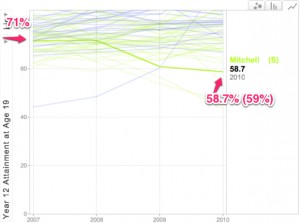
Yr 12 Attainment At a local level, I note that in the Shire I live in, Mitchell Shire, the Year 12 attainment rate for young people has dropped from 71% in 2007 to a startling 59% in 2010 [the fourth lowest in all LGA’s in the State].
There are a number of other metric’s I could point to, but this serves to make my point I hope.
How does anything that relates to the current position of Government to the teacher’s agreement, suggest this position will or can be improved?
How does having less skilled, less-schooled, less trained individuals in our community good for business or investment, let alone, the individuals themselves or the communities they live in?
My recent observations about the lack of co-ordinated support for telecommunications infrastructure in the region further supports structural inequities that belie the social contract.
Public debate and discourse appears to have collapsed and we have ridiculously doctrinaire views from political parties and commentators that frankly, in the 21st century, serve no-one, except perhaps the [increasingly] narrow self-interests of the few in power. The status-quo is well served.
Scanning the newspapers in New South Wales and Victoria today, provides a stunning treatise of potential corruptions, conflicts-of-interest, self-interest and just plain apparent incompetence that sadly, supports my basic premise.
We need to be smarter.
And ethical.
There appears to be genuine challenges of competence on both sides of the ever-increasingly irrelevant aisles of power.
We have a new Premier of the State and I doubt anyone understands why?
This will cover our news and air-waves for weeks.
It seems if one side of politics says it is raining, the other side will suggest it is sunny and what was once a fearless and informed fourth-estate, chooses to publish the controversy of the disagreement, rather than take the time to look out the window and report the facts.
In the mean-time, tens of thousands of public school educators remain without any reasonable commitment to the individual and profession-wide resources they require to respond to the needs of vastly diverse and rapidly balkanising communities. Evidence-led, place-based planning has never been more critical.
I am reminded of an opine from 2005 [I think from Barry Jones] when he referred to the rise of the “un-reading managerial class” in modern policy circles.
I don’t see what has changed.
While I can be considered a “partisan” [in the broader meaning] when it comes to supporting state education, I do consider myself rationale and collaborative, [Bruce, please don’t snigger..] and thus able to see areas of reform that require all stakeholders to be prepared to compromise the tactical, to achieve a shared strategic vision.
As yet,as far as I can tell, such a vision has not been articulated nor necessarily sought.
Management appears easier.
Nevertheless, the signal to noise ratio is such in public debate, that I simply add my voice to the ocean of noise, if only to satisfy myself and the few hundred colleagues, here and abroad that I share my views with.
Settling the teacher’s Enterprise Bargaining Agreement would be the first indication that we can and want to get smarter.
-
Education, Competitiveness, Civil Society – Pick 2
We shouldn’t have to!

AEU Stop-work, Melbourne 5 Sept 2012 It appears from contact with family and colleagues at what appears to be the largest state-wide teacher stop-work action ever held in Melbourne, Australia today, we are still very much in the cycle of what I like to call “retail economics and policy planning”.
It is sad to see such limited public debate about what is REALLY happening in schools, not just in Victoria, but across the country.
At a time when we have more information, data and knowledge about both TEACHING and LEARNING, we are still destined for what appears to be a policy debate that does not get much beyond either “kicking a teacher” or demanding unlimited funds with little or no accountability.
It is an insult to offer those in the service of educating our young such limited salaries, career structures and resourcing. Likewise, this will always appear to be the case as long as the teaching service allows a quasi-profession to be externally controlled, cajoled and manipulated because it does not manage and oversee its own standards and status.
It seems, the major actors in current policy are happy to frame the debate in terms of choices that perhaps even Faust would not consider. Although such policy positions play well on TV and Radio i.e “We need to reform teaching”, “we need to get rid of poor teachers” or “our schools are crumbling”, ” our rankings are falling”, we seldom discuss the opportunities a bi-partisan, multi-party commitment to education would bring to the country as a whole.
The half-truths and selective reasoning for political-gain, [at all levels] while well-crafted, is simply that, well-crafted. Our lack of cohesion and focus, our lack of collective support for the teaching service as one of the key strategic industries of our country’s current and future prosperity, is the key to many other social and economic policy dilemmas. Just ask the residents of Hackney.
We have in fact seen enrolments in non-government schools reach approximately 34% of total enrolments and yet concurrently, we have seen the rise of policy and public debate about “falling standards” and “falling rankings”. The shift of student enrolments to non-government schools [without apparent academic improvement] and the concentration of lower-performing students in many government schools is a challenge often simply ignored, it appears, by many policy makers.
Spending & OECD Performance
A lot has been made of discussions about spending and OECD rankings in the last few weeks and months. Here is a little chart that shows spending as a percentage of Gross Domestic Product and the OECD Country Rankings in PISA Tests in Maths, English and Science.
Dear reader, I would simply ask you to look closely at this graph below and ask yourself a few things about Australia’s rankings, mindful of the fact that MOST of the TEACHERS that were responsbile for the PISA results in 2000 are still in schools now.
Question. What has changed?
Question: What should we do now?
This chart requires flash.
Could you pick two of these? Education, Competitiveness, Civil Society
-
Strengthening Community Organisations
The Victorian Government has released the Victorian Government Action Plan: Strengthening Community Organisations.
A significant outcome is the establishment of the Office for the Community Sector at the Department of Planning and Community Development. It will be responsible for implementing the plan which addresses the streamlining of bureaucratic processes; workforce development in the community sector; and ongoing sustainability for community organisations.
Link: Launch of new action plan for Victorian community organisations.
-
School Councils Get More Training
School Councils Get More Training.
As school communities across the State begin their election processes for 2007, the Minister for Education, the Hon. John Lenders, has released new materials to support all school councils.
Thousands of parent, community and teacher volunteers who sit on Victorian government school councils will now have the opportunity to be formally trained, the Minister for Education, John Lenders, said today.
Releasing new training and support materials for school councillors, Mr Lenders said school councillors who devote significant time and energy to creating the best possible learning environment for students will be better supported.
“School councillors play a vital role in the decision-making process, building community partnerships and determining the direction of the school,” Mr Lenders said.
“I’d like to thank school councillors across the state for their valuable work and the time they give up to benefit Victorian children.
“We want to ensure that councillors are not only recognised for their contribution but provided with first-rate training and training and support materials.
“School councillors play a vital role in the decision-making process, building community partnerships and are central to the efficient running of our schools.
“We need to ensure that school councillors are properly supported to carry out their work and meet challenges of the future.
“That’s why we have developed this comprehensive training and support package for new, existing and prospective school councillors.”
With school council elections under-way, Mr Lenders also encouraged more parents to consider nominating for school council.
“Not only is it a chance to contribute to society in a productive way, it is a chance to be involved in your child’s education and school and get to know other parents and teachers,” he said.
The materials include a website with advice to schools, training modules, induction sessions for new school councillors and information sheets.
In addition to the web materials, training will cover, school finance, policy development, school strategic planning and effective meetings.
Schools are encouraged to get in touch with their regional office to access training. The launch of the new support materials follows the Review of School Governance in Victorian Government Schools completed in 2005.
For more information on support for school councils visit www.education.vic.gov.au
[ Source: Dept Premier and Cabinet ]
Related Links:
- CRLLEN Joint School Council Forum 2005
- CRLLEN ‘Three Pillars’ Industry and Community Forum
Education Victoria – School Councils Home Page
-
Parliamentary Committee Inquires in to Retaining Youth
All members of the LLEN should note the work of the Victorian Rural and Regional Services Development Committee and the Outer Suburban/Interface Services and Development Committee of the Parliament of Victoria. Over the past year the Central Ranges LLEN has given sworn evidence, made submissions to or assisted other groups to contribute to these three inquiries.

On January 19th, 2006, the Rural and Regional Services and Development Committee received terms of reference for an Inquiry into Retaining Young People in Rural Towns and Communities. The Committee is required to report to the Parliament by June 15th, 2006.
The terms of reference require the Committee to identify and examine the factors that influence young people to remain in rural communities, or to leave them; and to recommend strategies that might lead to more young people remaining in or returning to rural communities.
The full Terms of Reference can be found by following the link on this page.
The Committee welcomes contributions to the Inquiry. Follow the link to the “How to Make a Submission” page for more information about how to contribute your views.
The deadline for submission is 28th April 2006.
Regional Telecommunications
On 3 June 2003, the Rural and Regional Services and Development Committee of the Parliament of Victoria received terms of reference to inquire into regional telecommunications infrastructure for business.The reference requires the all-party Committee to inquire into the potential benefits to Victorian regional businesses from improved access to telecommunications infrastructure and services, in particular broadband infrastructure and services, and highlight any impediments that may stop businesses realising this potential.
The Central Ranges LLEN has provided sworn statements to the Regional Telecommunications review. This can be found here.
Inquiry into Building New Communities
To inquire into and report to Parliament on issues relating to strengthening communities through improved community engagement in outer urban areas, including both developing and established communities.
In particular, the Committee is requested to
The Committee is to make its final report to Parliament no later than 31 March 2006.
Related Links:
- Inquiry on Regional Telecommunications Infrastructure for Business
- Inquiry into Building New Communities
- Inquiry into Retaining Young People in Rural Towns and Communities
Link: Parliamentary Committee Inquires in to Retaining Youth
-
Elite-selection schools belong back in the ’30s
Richard Teese:
THE principals of MacRobertson Girls’ School and Melbourne High School have mounted a remarkable defence of their schools as historical champions of meritocratic equity (“Select schools benefit all state students”, Opinion, 27/11). Not that that was the point they should have addressed. Which was why have more. But alas, how history deserts those unfaithful to it, who present only parts of it! These two schools continue to shelter under the 1932 Education Fees Act, which attacked public secondary education in this state, targeting the poor. After the war, the schools clung on to their elite-selection role, while being forced to broaden their school catchments and limit their impact on other high schools………
…….Our task is to create learning environments in every school that support the whole range of students, even if the program emphasis may well vary. Exporting students from one site to another in search of relative individual advantage is no solution. The international evidence supports Stephen Lamb’s argument (Opinion, 21/11) that segregation weakens opportunities for poorer students, while intensifying the advantages of better-off students. Of course, one group is not responsible for the other group. But a good school nourishes both, neither culling one nor creaming the other.
The full letter can be found by following the link to The Age.
Links: