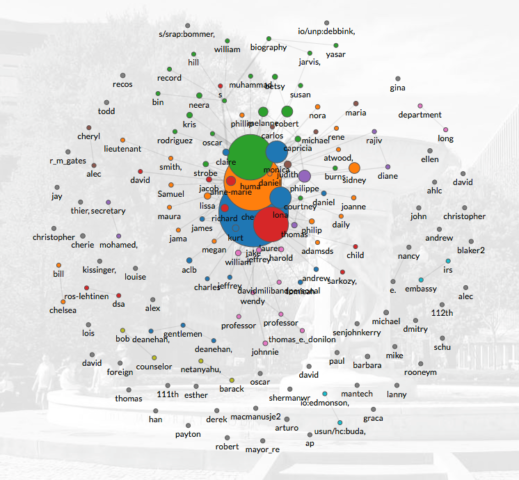
The Clinton Circle, maps emails from Hillary Clinton, John Podesta and the DNC in the United States.. Certainly topical!
The data is entirely sourced from WikiLeaks, and was last updated on Sun Oct 30, 2016.
People-centric view of email
ClintonCircle was not created to visualize these emails, but it is a fork of a tool called Immersion that they launched in 2013 that helps people visualize and understand the networks they weave through email interactions. They say:
Immersion is an invitation to dive into the history of your email life in a platform that offers you the safety of knowing that you can always delete your data.
[Source: Hillary Clinton MIT Macro Connections]
Macro-Connections study collective learning at @MIT@medialab by looking at the evolution of what people make, and by making tools to improve how they communicate.
At a time when reason and evidence appear under siege, and “belief” and “opinion” have a seeming privileged status in civil discourse unknown since the enlightenment, I am reminded of the words of the 17th Century Dutch Philosopher, Spinoza:
The highest activity a human being can attain is learning for understanding, because to understand is to be free.
The year my father was born, 1916, Albert Einstein pondered the universe and produced his General Theory of Relativity [ Die Feldgleichungen der Gravitation ].
This theory posits that the force of gravity is a “warping” of space itself. When gravitating objects move, they generate a “ripple” in space.
When such a ripple passes the Earth, our local space is alternately stretched and compressed, rather as, when a stone is thrown into a pond, the induced outward-moving wave causes the water at any point to cyclically rise and fall – but by a tiny amount.
Keith Riles, from the University of Michigan points out that
Einstein was skeptical that gravitational waves would ever be detected because the predicted waves were so weak. Einstein was right to wonder – the signal detected on September 14, 2015 by the aLIGO interferometers caused each arm of each L-shaped detector to change by only 2 billionths of a billionth of a meter, about 400 times smaller than the radius of a proton.
Szabolcs Marka, a physics professor at Columbia University, told CNN that “we will be able to study not just Einstein’s general relativity — we’ll be able to find objects we only imagined would exist. We should see a universe that has never been observed before.”
September 14th 2015
The gravitational waves were detected on September 14, 2015 at 5:51 a.m. Eastern Daylight Time (09:51 UTC) by both of the twin Laser Interferometer Gravitational-wave Observatory (LIGO) detectors, located in Livingston, Louisiana, and Hanford, Washington, USA. The LIGO Observatories are funded by the National Science Foundation (NSF), and were conceived, built, and are operated by Caltech and MIT. The discovery, accepted for publication in the journal Physical Review Letters, was made by the LIGO Scientific Collaboration (which includes the GEO Collaboration and the Australian Consortium for Interferometric Gravitational Astronomy) and the Virgo Collaboration using data from the two LIGO detectors.
A Cosmic Microphone
Marka said to think of it as a “cosmic microphone,” an incredibly precise listening device that can detect distortions in space-time, the fabric of the universe. It’s so precise it can detect changes the size of a soccer ball in the entire Milky Way galaxy.
The discovery of gravitational waves is like opening another of our senses, hearing the universe as well as seeing it.
And when we hear the universe, we will learn about the secret life of black holes — their birth, their death, their marriage, their feeding. We will hear when a black hole eats a neutron star.
Gravitational Waves
Two Black Holes Collide
[Source: LIGO – CalTech 2016 ]The collision of two black holes holes—a tremendously powerful event detected for the first time ever by the Laser Interferometer Gravitational-Wave Observatory, or LIGO—is seen in this still from a computer simulation. LIGO detected gravitational waves, or ripples in space and time generated as the black holes spiraled in toward each other, collided, and merged. This simulation shows how the merger would appear to our eyes if we could somehow travel in a spaceship for a closer look. It was created by solving equations from Albert Einstein’s general theory of relativity using the LIGO data.
[Source: Physical Review Letters & C. Henze/NASA Ames Research Centre ]The two merging black holes are each roughly 30 times the mass of the sun, with one slightly larger than the other. Time has been slowed down by a factor of about 100. The event took place 1.3 billion years ago.
General Relativity – In a Nutshell
Albert Einstein explained that what we perceive as the force of gravity in fact arises from the curvature of space and time.
He found that space and time were actually interwoven into a single continuum known as space-time.
As he worked out the equations for this general theory of relativity, Einstein realised that massive objects caused a distortion within this continuum.
Imagine a large body in the centre of a trampoline. The body would press down into the fabric, causing it to dimple. If a marble was then rolled around the edge, it would spiral inward toward the body, pulled in much the same way that the gravity of a planet pulls at rocks in space.
He proposed that objects such as the sun and the Earth work in a similar way. In the presence of matter and energy they can evolve, stretch and warp, forming ridges, mountains and valleys that cause things moving through to zigzag and curve.
Einstein determined that massive objects (like the Earth) cause a distortion in space-time which is felt as gravity.
Most MBAs aren’t worth the paper they’re printed on, suggests Henry Mintzberg. “Management is where art and craft and science meet,” and most MBA programs are simply “training in analytical skills for analytical jobs… like investment banking and consulting.” Whatever you do, don’t confuse an MBA with a license to manage. “If people want to be managers, there’s a better route to it: get into an industry, know it, prove yourself, get promoted into a managerial position—and then, go to a program that uses managerial experience explicitly—not other people’s cases, but your own experience.”
Alan Brody, Evan Ziporyn, Jay Scheib, Krzysztof Wodiczko
High tech tools have become a means for both creating and communicating art. For some of the symposium panelists, this poses a mixed blessing. Evan Ziporyn describes the evolution of his musical composition…