Victoria changes… @DELWP_Vic #demography https://t.co/cicAJkWv0N pic.twitter.com/dLRwdlWnQP
— WhaleSongServices (@WhaleSongAus) November 13, 2015
Tag: Demographics
-
Victoria in the future…
-
Don’t Panic: How to End Poverty in 15 Years
The Middle…
Once again, Hans Rosling, Professor of International Health at Karolinska Institute and co-founder and chairman of the Gapminder Foundation, reminding us [ with data] just how much development has occurred across the globe in just 200 years.
Links
-
Harsh Reality..The World is Better!
Confirmation bias, idealogical/doctrinaire policy “imperatives” or good-old special interests are all part of what contributes to our sense of progress in the human condition.
Max Roser is a James Martin Fellow researching income inequality and inclusive growth at the Institute for New Economic Thinking, Oxford Martin School. Roser asks the question:
Is it actually true that we are building a better world? Or are those who claim that things are always getting worse the ones in the right? Whether we’re discussing the way of the world over a pint in the pub or dissecting the issues at an academic conference, it’s a topic that lingers constantly: how is the world changing?
Roser points out in a series of research that:
- incomes are growing in all parts of the world,
- world poverty is declining rapidly
- and that the poorest countries now have the highest growth!

[ Human Development – Source: Max Roser via Prados de la Escosura (2014) – CC BY-SA License Roser’s response in unequivocal.
The answers to my initial questions are very clear. The evidence shows that we are becoming less violent and increasingly more tolerant, that we are leading healthier lives, are better fed, and that poverty around the world is declining rapidly. Taking these facts into account paints a very positive picture of how the world is changing.
Links
-
22,999,000 and counting
Australia’s population will reach a “projected” twenty three million today, Tuesday 23rd April 2013.
22,999,515
Those working in regional development, government and community understand the strategic challenges and opportunities changes in population and demographics brings.
On a personal note, we contributed to this total exactly sixteen years ago today!! [Grin]
Notes:
This projection is based on the estimated resident population at 30 September 2012 and assumes growth since then of:
- one birth every 1 minute and 44 seconds,
- one death every 3 minutes and 32 seconds ,
- a net gain of one international migration every 2 minutes and 19 seconds, leading to
- an overall total population increase of one person every 1 minute and 23 seconds .
Links:
-
Our Aging Population
Another very nice piece of work visualising data.
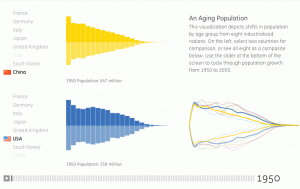
Our Aging World Visualizing.org is displaying some animated age-pyramids that tell a unique story of the challenges of growth in the coming decades.
From the site:
On October 31, 2011, demographers at the United Nations reported that the earth’s population had reached 7 billion. That number marks an increase of 1 billion in a single decade, and is projected to approach 9 billion by 2050. Data visualization can help us understand the evolving demographic composition of the world population, the economic implications of such growth, and the challenges we must overcome to accommodate a global community of 7 billion with Earth’s limited natural resources.
We know that the long term trend for TOTAL global population is slowing and will plateau, somewhere in the range of 7.5 and 10.5 billion by 2050. We also know that most of the rapid growth and the families with 4-5 + children per family are in sub-Saharan Africa, whilst many other modern economies are at or below replacement-rates for their populations. So while the overall global trend is positive, regionally, the variations are huge.
The impact for resource use, resource allocation and global co-operation remain profound.
Links:
-
Global Health
Our new book on GLOBAL HEALTH is out!!

Is it possible to write a book on the health of all 6.5 billion persons living on the globe? Well we did it and now it is on sale from Monday 27/11 2006.We are six authors, but it was Ann Lindstrand who got it together and Birgitta Rubensson that brought it to print. Hundreds of students read and commented various versions.
We wrote it for those that in a short text want to learn:
-how the health of the world’s population has changed over time;
-how the main determinants of health varied with time and place;
-how health can be measured;
about the causes of the main diseases in the world;
-what health care that exist around the world.Our book is a summary of the works by greater scholars on global health. The pros with our book are the overviews; the cons are the simplifications and errors that are a consequence of our broad ambitions. – Hans Rosling [Hans Rosling]
-
Low birth rate to hit school enrolments
Australia’s school population will start to fall within two years as the country’s declining birth rate makes an impact on enrolments, according to a new report.

