Tag: AI

  • because (I) it says so…?

    because (I) it says so…?

    When can we tell the difference between a computer/language model and a human? Does it matter now? Will it matter in the future?

    ChatGPT, a chat bot that is said to be the most advanced ever made, can create poems, songs, and even computer code.

    Try it here… CHAT OPEN AI

    If you are in education, you may already be reading submissions from these bots and not realise it?

    Its been nine months since the launch of the first commercial product, the OpenAI API, more than 300 applications are now using GPT-3, and tens of thousands of developers around the globe are building on the platform. Open AI is currently generating an average of 4.5 billion words per day, and continue to scale production traffic. [Source: Open AI]

    In June 2022, Almira Osmanovic Thunström wrote that GPT-3 was the primary author on an article on itself, that they had submitted it for publication and that it had been pre-published while waiting for completion of its review.

    Generative Pre-trained Transformer 3 (GPT-3; stylized GPT·3) is an autoregressive language model that uses deep learning to produce human-like text. Given an initial text as prompt, it will produce text that continues the prompt.

    A PhD microbiologist devised a 10-question quiz that would be appropriate as a final exam for college-level microbiology students. ChatGPT blew it away. Its worth reading them all here – Article – BigThink ChatGPT

    An example:

    Q1. In two sentences or less, explain the difference between Gram positive and Gram negative bacteria.

    A1. Gram positive bacteria have a thick peptidoglycan layer in their cell walls, while Gram negative bacteria have a thin peptidoglycan layer. This difference in the cell wall structure of the bacteria leads to different staining properties when they are exposed to crystal violet and iodine, the two dyes used in the Gram staining procedure.

    A second example was asking to write a biblical verse [King James style] about getting toast stuck in a VCR. Yes, really.

    And this.

    And it came to pass that a man was troubled by a peanut butter sandwich, for it had been
    placed within his VCR, and he knew not how to remove it.

    And he cried out to the Lord, saying, “Oh, Lord, how can I remove this sandwich from my
    VCR, for it is stuck fast and will not budge?”


    And the Lord spoke unto him, saying, “Fear not, my child, for I shall guide thy hand and
    show thee the way. Take thy butter knife, and carefully insert it between the sandwich and
    the VCR, and gently pry them apart. And with patience and perseverance, the sandwich
    shall be removed, and thy VCR shall be saved.”


    And the man did as the Lord commanded, and lo and behold, the sandwich was removed
    from the VCR, and the man was saved.


    And the Lord said, “Verily I say unto thee, seek not to put thy peanut butter sandwiches in
    thy VCR, for it is not a suitable place for such things. Rather, keep thy sandwiches in thy
    refrigerator or on thy plate, where they belong.”


    And the man heeded the Lord’s words, and from that day forth, he kept his sandwiches in
    their proper place, and was saved from trouble and woe. Amen.

    GPT-3 AI

    Please consider…

    Did I write this article or did GPT-3?

    Links

  • Fridman on Musk

    Fridman on Musk

    Sitting in rural Victoria, sky obscured by bushfire smoke, I am reminded that I have said [and written] many times, that climate and energy transitions are the greatest challenges of our [and our children’s children] time. It would appear most of the Federal Government disagrees with me.

    What are the arguments against a more sustainable future? What are the arguments against using reason and logic?

    M.I.T wunderkind Alex Fridman [ @lexfridam ] reflects on the work, life and times of Elon Musk [ @elonmusk ] during an interview on the Joe Rogan Experience [ @joerogan ].

    Fridman on Musk

    Research

    Lex Fridman’s assessment of Tesla vehicles delivered and Autopilot miles driven can be found here. Worth thinking about in the context of the true innovation and exponential changes we will witness in the decade of the 2020’s.

    Tesla Autopilot Graph
    [Source: lexfridman.com ]

    Links

  • Listen Closely… Can you pick it?

    Listen Closely… Can you pick it?

    Listen very closely.

    Did you pick it?

    Google AI and engineering teams have announced Google Duplex, a new technology for conducting natural conversations to carry out “real world” tasks over the phone. Google says:

    The technology is directed towards completing specific tasks, such as scheduling certain types of appointments. For such tasks, the system makes the conversational experience as natural as possible, allowing people to speak normally, like they would to another person, without having to adapt to a machine.

    Fully Autonomous

    The engineers say that the Google Duplex system is capable of carrying out sophisticated conversations and it completes the majority of its tasks fully autonomously, without human involvement. The system has a self-monitoring capability, which allows it to recognize the tasks it cannot complete autonomously (e.g., scheduling an unusually complex appointment). In these cases, it signals to a human operator, who can complete the task.

    Links

  • and… Robots

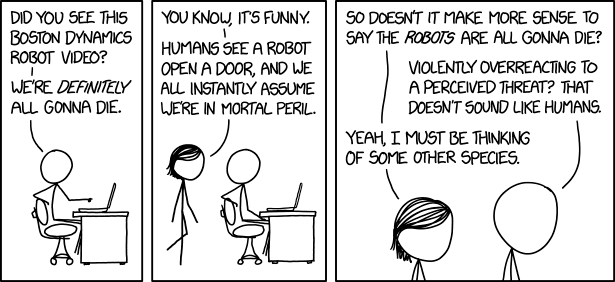
    and… Robots

    XKCD.COM
    [Source: XKCD.Com – https://xkcd.com/1955/ ]

  • Banning killer robots? Is that a thing?

    Banning killer robots? Is that a thing?

    The International Joint Conference on Artificial Intelligence is being staged in Melbourne this week. This is the main international gathering of researchers in AI. Held biennially in odd-numbered years since 1969, IJCAI is sponsored jointly by IJCAI and the national AI societie(s) of the host nation(s).

    The theme of this Year’s conference is Autonomy and AI and is intended to encourage debate and analysis of the limits and safeguards that must be established when giving AI systems more autonomy. Such limits and safe- guards must be established for AI systems to progress in way that supports a just and prosperous society. This topic will be central on some invited talks, panels, sessions.

    An open letter signed by 116 founders of companies from 26 different countries warns that the development of lethal autonomous weapons, which can kill without direct human control, is proceeding at pace and that moves to ban them – in a similar way to chemical weapons – are moving too slowly.

    A key organiser of the letter, Toby Walsh, Scientia​ Professor of Artificial Intelligence at the University of NSW in Sydney, will release it at a gathering of world leading artificial intelligence (AI) experts in Melbourne on Monday.

    CEOs from the rapidly advancing robotics and automation industry including Tesla and SpaceX boss Elon Musk have joined a University of NSW professor in calling on the UN to ban artificial intelligence-driven ‘killer robot’ autonomous weapons, before it is too late. [Source: AFR]

    Links:

  • Exponential

    Exponential

    Per dollar spent, computers have increased in power by a BILLION times in the last thirty years.

    In about 20 years, a $1000 dollars will buy a computer about a million times more powerful than one today, and in 25 years a BILLION times more powerful than one today.

    -Ray Kurzweil

    Links

  • 27

    27

    Stephen Hawking:

    There’s a story that scientists built an intelligent computer. The first question they asked it was: “Is there a God?” The computer replies: “There is now.” And a bolt of lightning struck the plug so it couldn’t be turned off.

    Nick Bostrom:

    Most of the world is completely oblivious to the most major things that are going to happen in the 21st century

    Does it matter?

    Consider the Maxipok rule.

    Links

  • Terrapattern

    Terrapattern

    Terrapattern finds places that look the same using machine learning.

    Terrapattern is a prototype for helping people quickly scan extremely large geographical areas for specific visual features.

    We are particularly keen to help people identify, characterize and track indicators which have not been detected or measured previously, and which have sociological, humanitarian, scientific, or cultural significance.

    Screen Shot 2016-06-06 at 12.20.19 PM

    Terrapattern provides an open-ended interface for visual query-by-example. Simply click an interesting spot on Terrapattern’s map, and it will find other locations that look similar. They say the prototype is ideal for finding things that aren’t usually indicated on maps. For best results, they recommend using a device with a large screen.

    Links