Tag: Mapping

  • Feeling a bit off?

    Feeling a bit off?

    Well, if you live in Australia, then don’t worry, you might be about 1.5 metres “off”.

    A team from GEOSCIENCE Australia are about to recalculate the nation’s latitude and longitude coordinates, which are currently out by more than 1.5 metres.

    Australia sits on the fastest moving continental tectonic plate in the world, thus coordinates measured in the past continue changing over time.

    The continent is moving north by about 7 centimetres each year, colliding with the Pacific Plate, which is moving west about 11 centimetres each year.

    It will improve the accuracy of all spatial information across the nation for a myriad of services including transportation, personal navigation and surveying.

    GNSS stations consist of permanent geodetic quality GPS receivers, on geologically stable marks, with eight stations within Australia known as the Australian Fiducial Network (AFN) . These stations provide the geodetic framework for the spatial data infrastructure in Australia and its territories. They also provide input for the measurement of earth processes, such as crustal dynamics and sea level rise.
    Links

  • Terrapattern

    Terrapattern

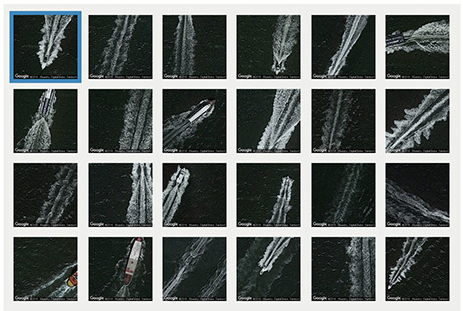
    Terrapattern finds places that look the same using machine learning.

    Terrapattern is a prototype for helping people quickly scan extremely large geographical areas for specific visual features.

    We are particularly keen to help people identify, characterize and track indicators which have not been detected or measured previously, and which have sociological, humanitarian, scientific, or cultural significance.

    Screen Shot 2016-06-06 at 12.20.19 PM

    Terrapattern provides an open-ended interface for visual query-by-example. Simply click an interesting spot on Terrapattern’s map, and it will find other locations that look similar. They say the prototype is ideal for finding things that aren’t usually indicated on maps. For best results, they recommend using a device with a large screen.

    Links


  • 25 Years

    25 Years

    Its not a long time, twenty-five years.

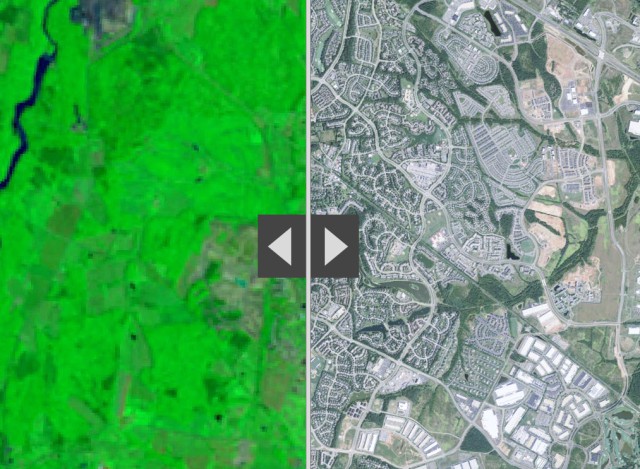
    ESRI [ @Esri ] has produced some excellent comparative analyses of Human activities that are reshaping the Earth’s surface using 1990 Landsat imagery [left] and Esri’s World Imagery basemap [right]

    ESRI Story Maps
    [ Human activities reshaping Earth’s surface – Source: ESR I]

    Links

  • Africa

    Africa

    Perspective is a wonderful thing.

    Africa Dwarfs China, Europe and the U.S.

    Scientific American – [Paywall]

  • Invisible Infrastructure

    The UK’s National Air Traffic Services offers an animated tour of just how flight paths are managed.

    A fascinating and beautiful visualisation.

    Links

  • Solar Potential Mapping

    Mapdwell

    Mapdwell’s web-based Solar System platform helps users design at-home solar energy systems: it visualizes the costs and benefits of installing a solar roof by layering information about tax credits and carbon emissions savings onto a topographical map of local roofs, and helps determine the most efficient spots for panels.

    Links

  • Real Time Radiation Monitoring

    Real-Time Geiger Counter feeds:

    This map uses crowd-sourced radiation geiger counter readings from across Japan.

    Japan Geiger Map
    Real-Time Geiger Counter Feeds

    http://japan.failedrobot.com/

    There are now hundreds of radiation-related feeds from Japan on Pachube, monitoring conditions in realtime and underpinning more than half a dozen incredibly valuable applications built by people around the world. They combine ‘official’ data, ‘unofficial’ official data, and, most importantly to us, realtime networked geiger counter measurements contributed by concerned citizens. Now we’re even seeing some tracking radiation measurements of tap water.

    There is also a new Safecast Global map.  Just stunning.. Have a look here.

    Note: Safecast is a volunteer organisation actively building a radiation sensor network within Japan and globally. Many of the crowd-sourced data points will originate from this effort.

    Link: http://blog.safecast.org/

  • Mapping Innovation

    McKinsey maps the world’s innovation clusters


    McKinsey Innovation

    How innovative is your city?

    McKinsey Digital has released a new innovation study of the world’s leading cities, grouping them into one of four different categories — “hot springs,” “dynamic oceans,” “silent lakes,” and “shrinking pools.” The most innovative cities are “dynamic oceans,” while the “hot springs” are the types of cities with a lot of economic momentum, but in need of a little Creative Class infusion to make them even more vibrant and diverse. In the chart above, Silicon Valley stands alone as the dominant innovation cluster in the world.

    While it’s not a real stretch to see Silicon Valley as the dominant “dynamic ocean” of innovation in the world, who knew that Kiel, Germany and Miyazaki, Japan are among the hottest up-and-coming innovation clusters in the world? (In fact, there’s a whole handful of Japanese cities that made the cut as “hot springs” of innovation) And, conversely, that New York, Chicago and Philadelphia are “silent lakes” of innovation? By some measures, even the Twin Cities are more vibrant than their East Coast counterparts.

    [chart: McKinsey Digital: Mapping Innovation Clusters]

    – dominicbasulto [Endless Innovation]

  • So Where is the LLEN?

    Where is the LLEN?.

    CRLLEN FRAPPR MapMapping the CRLLEN

    A handy little tool called ‘FRAPPR’ and using the power of Google Earth, we have been able to map the location of members of the LLEN and users of our web site.

    The map opposite shows the distribution of around 40 members of the Central Ranges LLEN.

    We know we have over 120 members of the association and over 170 subscribers to the Web Site from 4 countries.

    It is completely voluntary, so why not consider sticking a pin in the map?

    To get the full details and some helpful hints about using this mapping technology and have a little fun along the way, point your web browser to: