
The Scripps CO2 measurements at Mauna Loa have been supported for many years by the U.S. Department of Energy (DOE), and have more recently been supplemented by Earth Networks, a technology company that is collaborating with Scripps to expand the global GHG monitoring network. Support for website development was provided in part by the National Science Foundation (NSF).
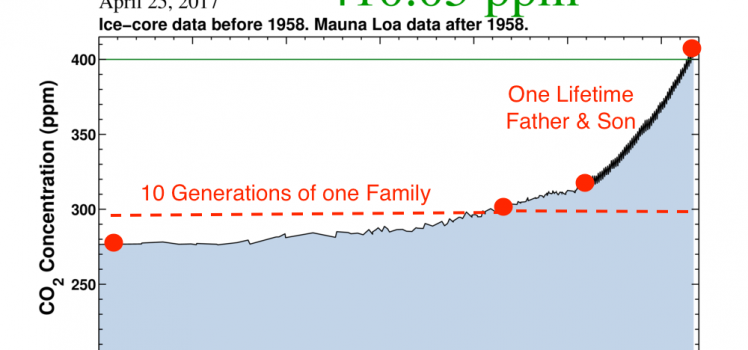
The daily average concentration of carbon dioxide in the air that day at Hawaii’s Mauna Loa Observatory was 399.68 parts per million. On November 12 it rose to 401.64 ppm, and it’s quite possible that we’ll never see another day in our lives with the daily Mauna Loa CO2 reading below 400 ppm.
That’s quite possibly the event-horizon of an Epoch whose membership is compulsory yet no-one wishes to [or realises] they have crossed.
Certainly the single largest public-policy issue. An existential challenge that appears to [still] evade definition.
Two Wednesdays ago, we sailed past a carbon milestone of perhaps geological scale. With CO2 levels above 400 ppm, atmospheric carbon in our era is now higher than it’s been in at least one million years—and perhaps in 25 million years. One of the world’s most respected climatologists now says that November 11 could be the last day of our lifetimes in which atmospheric carbon stays below 400 parts per million.
Ralph Keeling, the climatologist responsible for the “Keeling Curve” and the very Professor at the Scripps Institution of Oceanography at the University of California San Diego who directs the program which oversees the Mauna Loa readings.
[Weekly Observation Mauna Loa ] and
[ Full Record Mauna Loa ]Professor Keeling notes:
“It’s too early to be 100 percent certain, but I agree that it’s starting to look like we are already over 400 ppm for this year, with the last daily and weekly values below 400 ppm occurring earlier this month,”
According to the UK Met Office their predictions now suggest that the global temperature in 2015 will, in all probability, be at least 1°C warmer than the preindustrial average.
CO2 Emissions modelling
[Source: Vox.com – How the world failed on Climate Change ]Henson points out that:
This would put our planet halfway to the 2°C warming that’s long been viewed by many scientists and policy experts as a level that significantly raises the odds of major climate disruption.
A brief video from the journal Nature, released last Thursday, serves as a quick guide to the origin and significance of the 2°C goal.
NOAA
In the same time period, NOAA released their latest global summary.
NOAA reports: The combined average temperature over global land and ocean surfaces for October 2015 was the highest for October in the 136-year period of record, at 0.98°C (1.76°F) above the 20th century average of 14.0°C (57.1°F).
This marked the sixth consecutive month a monthly global temperature record has been broken and was also the greatest departure from average for any month in the 1630 months of recordkeeping, surpassing the previous record high departure set just last month by 0.13°F (0.07°C).
The October temperature is currently increasing at an average rate of 0.06°C (0.11°F) per decade.
This thing is still growing and it’s definitely warmer than it was in 1997,” said Bill Patzert, climatologist with NASA’s Jet Propulsion Laboratory in La Cañada Flintridge. As far as the temperature readings go, “it’s now bypassed the previous champ of the modern satellite era…