Tag: History

  • Taking Sides

    Taking Sides

    Thirty Years ago today, Elie Wiesel was awarded the Nobel Peace Prize. I remember this well. His words resonated for a young teacher…

    … and the boy asks: “What have you done with my future…”

    And then I explained to him how naive we were, that the world did know and remain silent. And that is why I swore never to be silent whenever and wherever human beings endure suffering and humiliation. We must always take sides. Neutrality helps the oppressor, never the victim. Silence encourages the tormentor, never the tormented. Sometimes we must interfere. When human lives are endangered, when human dignity is in jeopardy, national borders and sensitivities become irrelevant. Wherever men or women are persecuted because of their race, religion, or political views, that place must – at that moment – become the center of the universe.

    Elie Wiesel’s Acceptance Speech, on the occasion of the award of the Nobel Peace Prize in Oslo, December 10, 1986

    Elie Wiesel
    [Elie Wiesel – Nobel Peace Prize 1986 ]

    It is with a profound sense of humility that I accept the honor you have chosen to bestow upon me. I know: your choice transcends me. This both frightens and pleases me.

    It frightens me because I wonder: do I have the right to represent the multitudes who have perished? Do I have the right to accept this great honor on their behalf? … I do not. That would be presumptuous. No one may speak for the dead, no one may interpret their mutilated dreams and visions.

    It pleases me because I may say that this honor belongs to all the survivors and their children, and through us, to the Jewish people with whose destiny I have always identified.

    I remember: it happened yesterday or eternities ago. A young Jewish boy discovered the kingdom of night. I remember his bewilderment, I remember his anguish. It all happened so fast. The ghetto. The deportation. The sealed cattle car. The fiery altar upon which the history of our people and the future of mankind were meant to be sacrificed.

    I remember: he asked his father: “Can this be true?” This is the twentieth century, not the Middle Ages. Who would allow such crimes to be committed? How could the world remain silent?

    And now the boy is turning to me: “Tell me,” he asks. “What have you done with my future? What have you done with your life?”

    And I tell him that I have tried. That I have tried to keep memory alive, that I have tried to fight those who would forget. Because if we forget, we are guilty, we are accomplices.

    And then I explained to him how naive we were, that the world did know and remain silent. And that is why I swore never to be silent whenever and wherever human beings endure suffering and humiliation. We must always take sides. Neutrality helps the oppressor, never the victim. Silence encourages the tormentor, never the tormented. Sometimes we must interfere. When human lives are endangered, when human dignity is in jeopardy, national borders and sensitivities become irrelevant. Wherever men or women are persecuted because of their race, religion, or political views, that place must – at that moment – become the center of the universe.

    Of course, since I am a Jew profoundly rooted in my peoples’ memory and tradition, my first response is to Jewish fears, Jewish needs, Jewish crises. For I belong to a traumatized generation, one that experienced the abandonment and solitude of our people. It would be unnatural for me not to make Jewish priorities my own: Israel, Soviet Jewry, Jews in Arab lands … But there are others as important to me. Apartheid is, in my view, as abhorrent as anti-Semitism. To me, Andrei Sakharov‘s isolation is as much of a disgrace as Josef Biegun’s imprisonment. As is the denial of Solidarity and its leader Lech Walesa‘s right to dissent. And Nelson Mandela‘s interminable imprisonment.

    There is so much injustice and suffering crying out for our attention: victims of hunger, of racism, and political persecution, writers and poets, prisoners in so many lands governed by the Left and by the Right. Human rights are being violated on every continent. More people are oppressed than free. And then, too, there are the Palestinians to whose plight I am sensitive but whose methods I deplore. Violence and terrorism are not the answer. Something must be done about their suffering, and soon. I trust Israel, for I have faith in the Jewish people. Let Israel be given a chance, let hatred and danger be removed from her horizons, and there will be peace in and around the Holy Land.

    Yes, I have faith. Faith in God and even in His creation. Without it no action would be possible. And action is the only remedy to indifference: the most insidious danger of all. Isn’t this the meaning of Alfred Nobel’s legacy? Wasn’t his fear of war a shield against war?

    There is much to be done, there is much that can be done. One person – a Raoul Wallenberg, an Albert Schweitzer, one person of integrity, can make a difference, a difference of life and death. As long as one dissident is in prison, our freedom will not be true. As long as one child is hungry, our lives will be filled with anguish and shame. What all these victims need above all is to know that they are not alone; that we are not forgetting them, that when their voices are stifled we shall lend them ours, that while their freedom depends on ours, the quality of our freedom depends on theirs.

    This is what I say to the young Jewish boy wondering what I have done with his years. It is in his name that I speak to you and that I express to you my deepest gratitude. No one is as capable of gratitude as one who has emerged from the kingdom of night. We know that every moment is a moment of grace, every hour an offering; not to share them would mean to betray them. Our lives no longer belong to us alone; they belong to all those who need us desperately.

    Thank you, Chairman Aarvik. Thank you, members of the Nobel Committee. Thank you, people of Norway, for declaring on this singular occasion that our survival has meaning for mankind.

    Tell me, he asks. What have you done with my future? What have you done with your life?

    Links


  • Digital Vellum

    Digital Vellum

    The Future of History

    An excellent interview by @onthemedia with Vint Cerf @vgcerf .

    The challenge of storing, archiving and retrieving data over time is not new. This challenges every individual with their tens of thousands of family “snaps”, every small business with their electronic accounts and customer databases and certainly every organisation and government producing “oceans” perhaps “galaxies” of data, content and material that MUST, SHOULD or MIGHT be preserved “indefinitely”.


    Links


  • Battlefields

    The Broadford Secondary College approach to understanding history.

    Impressive.

    Students from across the year levels at  Broadford Secondary College will be travelling again to England, Belgium and France to study and experience first-hand, the battlefields of the First and Second World Wars 1914-18 and 1939-1945.

    They have been honoured by an invitation to lay a wreath at the Menin Gate.


    Context

    Battlefields Tour 2013
    [BSC Battlefields Tour 2013]

    Links

  • The first time…

    and Today…


    Baby and Tablet
    Source: Hunt4Truth

  • ANZAC Day – Mine – Theirs – Ours

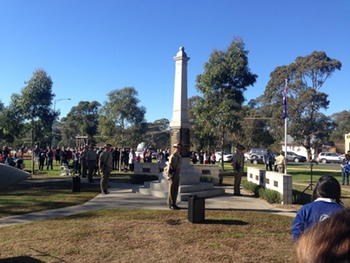
    Broadford Cenotaph 2014
    Cenotaph – Broadford

    The Broadford ANZAC Day Commemoration was once again a solemn and moving ceremony.

    The Broadford Branch of the RSL [Returned and Services League] is to be commended. To see so many hundreds of people attend, demonstrates both the high regard for the Broadford RSL and the importance with which this commemoration is held in the community.

    This particular event held even more interest for me this year for a number of reasons.

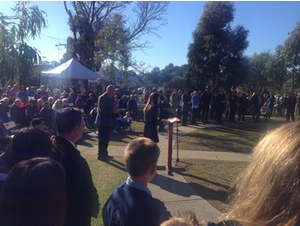
    Anzac Speech
    Anzac Day Speech – Grace Coppinger

    My daughter, Grace, was given the honour and privilege of delivering the Anzac Address [speech] at the Ceremony on behalf of all the young people that attended the recent Broadford Secondary College Battlefields Tour to France and Belgium.

    Some of those attending at the Cenotaph have experienced war.

    Many of those attending the ceremony have families that experienced war, suffered great loss and have their family members names on the Broadford Cenotaph.

    There are no longer any veterans from World War 1 still alive today, so to some, it might seem quite odd that a 17 year old schoolgirl would make the speech at an Anzac Day commemoration.

    In recent weeks there has been, sadly,  a mild-controversy amongst the local community [and some considerable disappointment for those involved] about one anonymous letter-to-the-editor [yes, they are always nearly anonymous] of a local newspaper, raising concerns about a recent study-tour by Broadford Secondary College students [of which both my Daughter and Son participated] to visit the battlefields of World War 1 and World War 11 in France and Belgium.

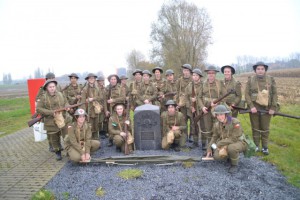
    The anonymous author raised [what I believe to be genuine but misguided and ill-informed] concerns about one image of the group of students dressed and equipped as World War 1 soldiers completing what is known as the “platoon experience” and perhaps ‘cheapening’ or ‘misundertanding’ the historical significance of ANZAC day.

    Platoon Experience
    Passchendaele – Belgium

    As a student of history, once professionally, and like many, having a personal interest, one understands that CONTEXT is everything.

    This particular historical experience was conducted based on the thoroughly researched historical sequence of events of the day, an experienced historian guided the group through the battlefields and the students were clothed in full uniform, equipped with a rifle and organised as a member of the platoon. Each member was briefed to take on the role of an Australian who was actually there and throughout the day learned more about him as a person. They also begun to understand the physical efforts required in the trenches, the mental challenges of battles at close quarters and perhaps, for a moment, considered their own age-group and just how similar the diggers were to them. Considerable research had been conducted into stories of those who served in this battle to create an authentic experience and honour the memory of their sacrifice.

    I doubt the anonymous writer experienced a history lesson like this in their school days.

    The students also traveled to:

    If you are left in any doubt as to what this one particular day of nineteen such days meant to the students, you should browse some of their online comments and live-diary entries here.

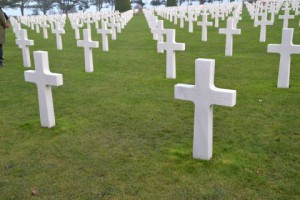
    Sea of white
    Sea of White

    You should also ponder the Sea-of-White by Emma G.

    I understand the concern for the solemnity of ANZAC traditions, yet also see a contradiction in the anonymous author’s logic. Sadly, “ownership” of traditions are those things in our culture that often create the most emotion and conflict and in this case, the anonymous author does not see or understand the full context of that image nor their own concern for “their”  tradition.

    We Will Remember Them

    If traditions are to remain resilient through time, particularly when the familial connection may not exist, then the young must come to experience and understand the importance of those traditions [so valued by the anonymous writer] and choose to adopt those traditions and values in their own context. This is not something that simply happens or is forced on a generation, this occurs because the young-person can understand the historical context and interpret its meaning for their modern lives.

    This does not simply happen. The professional expertise of teachers and educators create environments that challenge and inform. Thankfully, Broadford Secondary College has many such educators that I am happy to say support my own children in their journey.

    Communities also support and nurture their young.

    The anonymous writer did not understand the context of their own comments, rather, they simply responded to an image and perhaps a misjudgment of the calibre of young-people living and studying in our community.

    If the anonymous writer considered more closely the quality of young people on the trip,  the deep and encouraging support and guidance they received from the community which included no less than:

    and many many other businesses, families and individuals providing support and assistance, then I am sure the anonymous writer would have had a greater understanding and no need to publish, anonymously, a criticism that was both ill-informed and poorly timed.

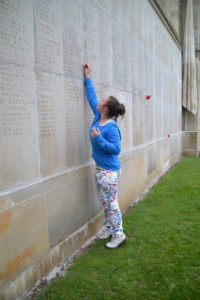
    A Poppy
    A Poppy – Emma

    Thankfully, the foresight and vision of those involved in the genuine stewardship of the ANZAC tradition, the members of the Broadford RSL, chose to recognise the young people from Broadford Secondary College that made the effort to tour across Europe by inviting one of their own to address the Anzac Day commemorative service.

    Many of the families in the local district had students visit the graves of family members.

    The students were visiting some graves of soldiers whose families have never been able to visit in-person.

    Others where visiting graves as representatives of families from the district that could not return. Others still, were simply offering a remembrance for an unknown soldier, because they chose to.

    Once such example of a remembrance:

    Today at the Villers Brettoneux cemetery, many students laid poppies or gave eulogies at the memorial site of their researched soldier. My solider’s name was Lambert Victor Gadd, given to me by Mrs Mary Dodge.

    At his memorial site, I read a poem by Wilfred Owen, called Arms and the Boy.

    Let the boy try along this bayonet-blade
    How cold steel is, and keen with hunger of blood;
    Blue with all malice, like a madman’s flash;
    And thinly drawn with famishing for flesh.

    Lend him to stroke these blind, blunt bullet-heads
    Which long to muzzle in hearts of lads.
    Or give him cartridges of fine zinc teeth,
    Sharp with the sharpness of grief and death.

    For his teeth seem for laughing round an apple.
    There lurk no claws behind his fingers supple;
    And God will grow no talons at his heels,
    Not antlers through the thickness of his curls.

    I know, at age sixteen, that I would not have had the consideration, foresight or emotional intelligence to make such a statement.

    From what I have seen and heard from those young people who attended the Broadford Secondary College Battlefields Tour and from the overwhelmingly and singularly positive responses from the attendees at the Anzac Ceremony, the traditions and values that the anonymous writer feared for and perhaps was unwilling to share, are, I can safely assert, alive and well in the next generation.

    A generation that understands and freely adopts the key messages of the ANZAC Tradition.

    As any good historian would say, don’t take my word for it, read the evidence and decide for yourself…

    You can read Grace’s words here. [PDF 35KB]

     Links


  • Melbourne in the 1960’s

    The National Film and Sound Archive have released some gems! For those of us who can remember!

    Link:

  • Amassing a Treasury of Photography.

    A Cornell Capa photograph of Jacqueline and John F. Kennedy campaigning in Manhattan in 1960.

    Two museums are at work on a project to create one of the largest free databases of masterwork photography anywhere on the Web. By RANDY KENNEDY.

    Link: Amassing a Treasury of Photography.