

Tag: Global Education

  • DULCE ET DECORUM EST

    DULCE ET DECORUM EST

    Now, more than ever, Education.

    So many emotions surround the senseless and barbaric acts that occurred in Paris this week. The tragic loss of life is simply unforgivable.

    There appears no defence against those secured in their delusional certainty by theocracy. As talk of further conflict escalates, one further example of the collateral [and more subtle] damage is closer to home.

    Now, more than ever, Education.

    A tour, by students from Broadford Secondary College, continuing a 25 year tradition of the “Global Classroom“,  over 18 months in the planning, was to depart for England, France and Belgium tomorrow the 20th of November. It will not proceed [sadly, but rightly so…]

    www.bscbattlefieldstour.net.au

    The tour was to provide students from this small country high school, the insights born of experience and context. “Living history” is an oft used [and often over-used] phrase, yet such experiences, I can attest, can be life changing.  Both my daughter and son participated in the inaugural tour, conducted by the college, in 2013. To say the experience “broadened their horizons” would be an understatement.

    Such programmes require enormous professional and personal commitment and dedication of teachers working with limited resources and equally trusting and supportive families willing to release the bonds of protection for the greater opportunity to “learn” and “know”.

    Of course, the debates about remembrance, glorification, perpetuation of flawed historical interpretations and all that is associated with the tired “either / or” view of history, is not my thesis today, nor thankfully, of those educators involved.

    The reality of some current global conflicts in the twenty-first century and their roots in the events studied by these students has been [at least partly] brought in to stark relief by the events of last week in Paris.

    The students have researched families and individual soldiers who died in the first war. They have reviewed the “history” books and had planned to make small commemorations on behalf of local families and organisations with relatives interred in France and Belgium.

    In particular, the students had been honoured with an invitation to make a presentation at the Menin Gate. Every single night since its opening in 1927, at 8.00pm, the road is closed in central Ypres,  while ‘The Last Post’, the traditional bugle call marking the end of the day for soldiers in action, is played. A hand-made wreath, consisting of numerous hand-made fabric poppies [which have been part of Broadford Secondary College’s contribution to the 5000 Poppie project.] was to be the centre-piece of this commemoration. A magnificent hand-made quilt, provided by over 30+ community members was also going to be the centre-piece of a presentation to French students.

    Wreath

    These opportunities no longer exist, yet the negativity, anger and disappointment for those involved is still real. Search for blame is always present in life’s disappointments. It was U.S. President Kennedy that said:

    Let us not seek to fix the blame for the past. Let us accept our own responsibility for the future.

    These are the challenges that make us realise the importance of sound, rational and secular education.

    The role of the teacher/educator is never more important than when the young ask “why”.

    Now, more than ever, Education.

    The lesson, experience and context for these students has been drastically changed by the events of the last week. Whilst the focus of global news services is on the “response” from Governments and the actors on the geo-political stage, I turn my attention to educators across the world and look to them for the responses that will signal the future. The real strategic commitment of resources within a civil society is yet to begin…

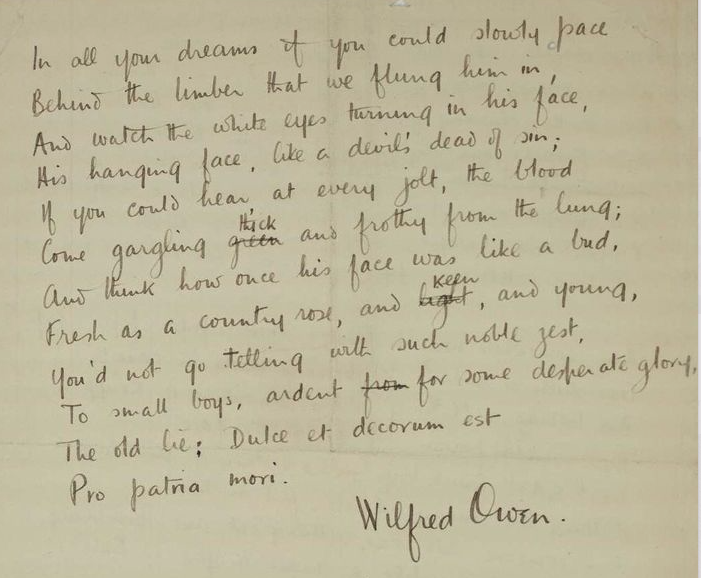
    As a student myself [many years ago], I am reminded of the genuine impact the poetry of Wilfred Owen had on me, challenging those without experience of the things they call for in others… It is as timely today, this very day, as it was on the gas-covered battlefields of the old world.

    The old Lie; Dulce et Decorum est Pro patria mori.

    Links

  • I*EARN 25 Years – Arte-Non-Vi

    Arte – non – vi : By skill, not – force. This is how lasting, peaceful change is made.

    IEARN 25 YearsAt the 25th Anniversary of the ground-breaking International Education and Resource Network [ I*EARN], I wanted to send a warm and heart-felt congratulations to all involved at the 20th International Conference in iEARN-Qatar/ROTA (Reach Out To Asia) in Doha, Qatar.

    Although I have not been teaching for almost 20 years, I wanted to pass on my congratulations and best wishes to all those involved in Qatar this year.

    I have little to share of the wonderful work that students completed in the early years, because my family lost all our belongings [and archives] in what was called the “Black Saturday Bush-fires” in 2009, here in Victoria, Australia.

    However, with the assistance and kind permission of the Australian Broadcasting Corporation [ABC] I have been able to share a mini-documentary “Internet Kids” about I*EARN Australia, and the Broadford students. This was broadcast nationally in 1995. I hope you enjoy this as a small snapshot of the history and early stages of I*EARN. I also have some historical links at the bottom of the page.

    Internet Kids – 1995

    Students from Broadford Secondary College were some of the first students in the world to be involved in Global telecommunications projects. In the late 1980’s and early 1990’s we built a small but strong network of schools using both traditional and very new [telecommunications] methods to connect our classrooms in what we then called in 1988, “The Global Classroom”. This was the title of the Year 8 Geography class!!

    The Australian Broadcasting Corporation [ABC] produced an episode of their mini-documentary series “Hot-Chips” on the work of Broadford Secondary College.


    Some Background

    In 1988 and 1989 [pre-world-wide-web] Broadford students began a project called the  ‘First Peoples” project. They began corresponding online with Jim Lovejoy and the students from G.A.T.E.S [Greater Alternatives to Education School] in Tacoma Washington, USA. Tranby Aboriginal College in New South Wales and via mail and phone with students representing indigenous Ainu communities in Japan. Netcomm Australia even supplied VERY high-tech modems for us. In 1991 we conducted a Five country Student teleconference (Year 8 Geography) for the Year of Indigenous Peoples and we established this on the I*EARN Conference systems as I*EARN First People’s project.

    That phone call cost over $250 dollars and lasted only about 60 minutes. That was a LOT of money… Today? Skype?

    In 1992, 22 Students from Broadford Secondary College visited Canada and the USA to meet with G.A.T.E.S. School students. This was the first-ever international exchange fro Broadford Students.

    The Broadford link with Japan still runs today, with students from Katsuta High School and Broadford Secondary College participating in exchange programmes and home-stays each year.

    Netcomm
    Netcomm Modem

    These were 2400 K dial-up modems. or those that know what a modem is, this will seem very funny now!

    We worked with a small network of local schools at first, including Broadford Primary SchoolPuckapunyal Primary School [who created one of the first “Share-a-friend/Teddy-Bear and Global Art Projects”] and Mansfield Secondary College who led the way with online environmental and water-quality projects. In the early years, we communicated using the NEXUS network from the Education Department of South Australia at Angle Park Computing Centre.

    Video-phone
    Video-phone

    In 1990-91 we even managed to be the first school in the Southern Hemisphere to use a Video-phone. Yes, this may have “perhaps” violated one-or-two telecommunications laws at the time, but we figured if we managed to get senior Education officials and Ministers in the picture, then we might not get in to too much trouble!![grin]


    This little group was later recognised in a speech in the Australian Federal Parliament in 1993.

    We convinced the Victorian Government [with excellent support from Bruce Rigby] to support our work and partner with our I*EARN Australia Centre and for two years they co-funded the Victorian Global Classroom Project, designed to support the professional development of teachers.

    Global Classroom 1995-1996

    The directors of the Whalesong Foundation consisted of Cathy Coppinger [Global Arts projects], Kathy Skidmore [Holocaust-Genocide project and International exchange] , Ian Parry [Asia Education International project] , Andrew Hocking [Globe project and International science * environment projects], Frank McNamara [ International literature & writing projects]  and myself.

    As full-time teachers, we also managed to personally provide training in 100 Victorian schools in the first year and a further 300 in the second year, all based on the I*EARN model.

    I*EARN

    Even in the earliest stages of what was to become the “internet” – [we were still working on systems that had to “cross” from one network to another], it became obvious to me that connecting with the early pioneers and trailblazers such as  Peter and Ed was something that would benefit all educators. I think after 25 years, my intuition is well supported.

    I was lucky enough to participate in the early planning stages of the I*EARN International network at Beaver-farm, New York, where I was privileged to meet Peter Copen and be exposed to such a grand vision for education and new technologies. Here I also met the human dynamo and perhaps the most committed educator I have ever-known, Ed Gragert.  Many of the team that would become the first International management team where at this meeting in New York.

    I am very proud to be able to call Peter and Ed my friends.

    In 1994 I was again privileged to attend the very first IEARN Conference in Puerta Madryn, Argentina, hosted by my good-friend Daniel Reyes. I still miss Daniel and his vision.  Here I met [among many] two amazing educators, Rosy Aguila and Adrianna Vilella.

    Rosy and Adrianna, your work inspired us all. Thank-you.

    Constitution
    I*EARN Constitution 1994

    The work in Argentina saw the creation of the I*EARN Constitution. My original, signed copy did not survive the fires, but believe it or not, I have been able to recover  a copy of that document from a digital archive stored offsite!!!

    It’s worth sharing those names, just so I can say thank-you publicly.

    Daniel Reyes [Argentina], Fu Li [China], Victor Minachin, [Russia], Gideon Goldstein [Israel], Daryl Bragg & Ken Evans [Mid-US], John Anderson, [Pacific North-West], Betsy Frederick [South West], Narcis Vives [Spain], Peter Baak [Netherlands], Earl Choldin [Canada], Chris Morton [New York].

    Thank-you.

    Twenty five years later, and look what has been built!

    Melbourne 1995 – IEARN 2

    The work and inspiration our small team [myself,Cathy Coppinger, Andrew Hocking, John Steele and Roland Gardiner]  experienced in Argentina in 1994 drove us to expand the work we began in 1989 and we set out to make sure the inspiration and achievements of the work in Argentina were not lost. We committed to hosting the SECOND I*EARN International Conference in Melbourne, Australia in 1995.

    With the support of Trish Bulluss, we hosted over 400 educators from 22 countries, expanding our little network of schools to a National Network that has continued to grow and prosper.

    As a follow-up to the Melbourne conference, students and teachers from over 35 schools attended the first PLANET I*EARN STUDENT FORUM which was held at the University of Melbourne on December 15th 1995.

    Though looking from afar, the work and achievements that have been created were, perhaps, dreamed of, but thought impossible in 1996.

    The work of the IEARN Australia team in the last twenty years should be roundly congratulated.

    I have very fond memories of my years in I*EARN. I was honoured to chair the I*EARN International Management Team for three years and was amazed at the power and depth of educators working together, across borders.

    I look forward to the next 25 years of I*EARN.

    Congratulations to all involved in Dohar, Qatar.


    Bill Coppinger


    Links

    * Note: The links I am providing here are to websites that are now archived. They used technologies dated as of 1996. Some of these sites are within “frames” of other sites and not designed to be easily or logically navigated, however they are the original documents and sites and I consider these to be of some historical interest/value and worth sharing.


  • Evidence-based Education in Africa

    I wonder what our current debates in Australia would or could contribute to the need to measure impact?

    Sub-Sharan Africa [Wikipaedia]The recent Evidence-Based Education:Policy-Making and Reform in Africa Conference raises numerous challenges, for not only an education system [Ghana], but policy makers across all sectors of Health, Education and Treasury throughout Sub-Saharan Africa.

    The Innovations for Poverty Action (IPA), and the Abdul Latif Jameel Poverty Action Lab (J-PAL) in collaboration with the Ghana Educational Service (GES) and support from the United States Agency for International Development (USAID) staged the two day event to review a large-scale evaluation of the Ghana Government’s Teacher Community Assistant Initiative (TCAI), aimed at improving literacy and numeracy levels in basic schools.

    The context of the work is data that shows within Sub-Saharan Africa that:

    • Net enrolment in primary school was 75% in 2009
    • Primary completion rates were 67% in 2009
    • In 2004, only 60% of students were able to progress to secondary school
    • Net enrolment in secondary school was 27% in 2008
    • Gross enrolment in tertiary institutions was 6% in 2008

    Natalie Colatosti and Laurence Dessein have an article here

    Links:

    First, Find out what works

    – Evidence-based Policy ” Build on or Spray on” David Halpern – Does Evidence Matter? [PDF]

    Random Trials for Service Provision