Category: Technology

  • Type 1 – Planet

    Type 1 – Planet

    What’s next?

    Opining the lack of type 1 people in public leadership? Federal Election. Climate change anyone?

    Looking back to look forward.

    In 1916, the year my father was born, we only knew of our own galaxy. Think about that for a moment…

    We did not think there were any other galaxies. Consider that in just over one lifetime, we have now observed/measured two black holes colliding with the Advanced Laser Interferometer Gravitational-wave Observatory (LIGO). Gravitational waves. We have come a long way. Perhaps.


    Gravity Wave - LIGO
    [Source: CalTech ]

    Energy

    Just as naively, many of the greatest minds of the earliest 20th century where adamant that producing energy from the breaking down of atoms was nothing more than “moonshine”. In fact, Sir Ernest Rutherford’s famous declaration [and centuries of ‘evidence’] was totally upended less than twenty-fours hours later by Leo Szilard when he announced the nuclear chain-reaction. He conceived the nuclear chain reaction in 1933, patented the idea of a nuclear reactor with Enrico Fermi in 1934, and in late 1939 wrote the letter for Albert Einstein’s signature that resulted in the Manhattan Project that built the atomic bomb. The rest they say, is history.

    That was completed in less time than the average student spends in school.

    In the span of my father’s and my own life-times, Nikolai Kardashev (a Russian Physicist) posited in 1964 what is now known as the “Kardashev Scale”.  Kardashev was looking for signs of extraterrestrial life within cosmic signals and developed a scale of energy/power usage.

    It has 3 base classes, each with an energy disposal level: Type I (10¹⁶W), Type II (10²⁶W), and Type III (10³⁶W).

    Kardashev Scale
    Indif [CC BY-SA 3.0 (https://creativecommons.org/licenses/by-sa/3.0)]
    • A Type I civilization—also called a planetary civilization—can use and store all of the energy available on its planet.
    • A Type II civilization—also called a stellar civilization—can harness the total energy of its planet’s parent star (the most popular hypothetical concept being the Dyson sphere—a device which would encompass the entire star and transfer its energy to the planet(s)).
    • A Type III civilization—also called a galactic civilization—can control energy on the scale of its entire host galaxy.

    The scale is hypothetical, and regards energy consumption on a cosmic scale.

    The salient point here is to note that the human race and planet earth is NOT on this scale.

    Not yet, ever?

    Even more puzzling is the growing awareness of the silence/lack of any obvious other example of a Type 1 or greater civilization anywhere in the observable universe.

    We understand the universe to be 13.8 billion years old.

    This is the Fermi Paradox, or more colloquially understood as “where is everybody?”.

    The Fermi paradox is named after the aforementioned physicist Enrico Fermi and refers to the apparent contradiction between the lack of evidence for and various high probability estimates of the existence of extraterrestrial civilizations elsewhere in just the (our) Milky Way galaxy.

    The basic points of the argument, made by physicists Enrico Fermi (1901–1954) and Michael H. Hart (born 1932), are:

    • There are billions of stars in the galaxy that are similar to the Sun, and many of these stars are billions of years older than the Solar system.
    • With high probability, some of these stars have Earth-like planets, and if the Earth is typical, some may have already developed intelligent life.
    • Some of these civilizations may have developed interstellar travel, a step the Earth is investigating now.
    • Even at the slow pace of currently envisioned interstellar travel, the Milky Way galaxy could be completely traversed in a few million years.

    According to this line of reasoning, the Earth should have already been visited by extraterrestrial aliens, or at least their probes.

    This may sound far-fetched, yet the law of big numbers is compelling. Many have described this as the challenge of all intelligent life. At some point, life “cracks the atom” and then faces “the great filter”.

    The Great Filter

    This probability threshold, which could lie behind us (in our past) or in front of us (in our future), might work as a barrier to the evolution of intelligent life, or as a high probability of self-destruction. The main counter-intuitive conclusion of this observation is that the easier it was for life to evolve to our stage, the bleaker our future chances probably are.

    The idea was first proposed in an online essay titled “The Great Filter – Are We Almost Past It?“, written by economist Robin Hanson. The first version was written in August 1996 and the article was last updated on September 15, 1998.

    Using extinct civilizations such as Easter Island as models, a study conducted in 2018 posited that climate change induced by “energy intensive” civilizations may prevent sustainability within such civilizations, thus explaining the lack of evidence for intelligent extraterrestrial life.

    Whatever the case, the notion of the anthropocene is increasingly valid and the national and global debates over energy sources, current and future, have starkly different trajectories for both the short term quality of life of millions and frankly, the sustainability of human civilization.

    Flying Blind

    With no evidence of intelligent life other than ourselves, it appears that the process of starting with a star and ending with “advanced explosive lasting life” must be unlikely. This implies that at least one step in this process must be improbable. Hanson’s list, while incomplete, describes the following nine steps in an “evolutionary path” that results in the colonization of the observable universe:

    1. The right star system (including organics and potentially habitable planets)
    2. Reproductive molecules (e.g. RNA)
    3. Simple (prokaryotic) single-cell life
    4. Complex (eukaryotic) single-cell life
    5. Sexual reproduction
    6. Multi-cell life
    7. Tool-using animals with big brains
    8. Where we are now
    9. Colonization explosion

    A sobering thought [understatement] when considering energy and climate policies that will set trajectories for life-times to come.

    It would be useful to have a few more Type 1 People in public life don’t you think?

    Michio Kaku is an American theoretical physicist and as early as 1991, was expressing as similar concern.

    Michio Kaku

    Carl Sagan – The Demon Haunted World

    I couldn’t send such a diatribe without a reference to the venerable (and increasingly prescient) Carl.

    “Science is more than a body of knowledge; it is a way of thinking. I have a foreboding of an America in my children’s or grandchildren’s time—when the United States is a service and information economy; when nearly all the key manufacturing industries have slipped away to other countries; when awesome technological powers are in the hands of a very few, and no one representing the public interest can even grasp the issues; when the people have lost the ability to set their own agendas or knowledgeably question those in authority; when, clutching our crystals and nervously consulting our horoscopes, our critical faculties in decline, unable to distinguish between what feels good and what’s true, we slide, almost without noticing, back into superstition and darkness.”

    Links


  • Data Industrial Complex

    Data Industrial Complex

    Is tech any different? Its all in the cloud! Cheaper is better, yeah?

    The concept of personal sovereignty versus ubiquitous personal technology is clearly something that motivates Apple CEO Tim Cook . Speaking at the 40th Annual International Conference of Data Protection and Privacy Commissioners in Brussels last week.

    The conference theme was “Debating Ethics: Dignity and Respect in Data Driven Life”.

    Cook is the first tech CEO to serve as the keynote speaker for the conference and was invited to speak.

    Links

  • Farewell – ETAOIN SHRDLU

    Farewell – ETAOIN SHRDLU

    A film created by Carl Schlesinger and David Loeb Weiss documenting the last day of hot metal typesetting at The New York Times.

  • A useful Drone

    A useful Drone

    On July 27, 2016, Michigan-based Vayu, Inc., in collaboration with the Stony Brook University Global Health Institute completed the first ever series of long-range, fully autonomous drone delivery flights with blood and stool samples, setting records in the process. The samples were flown from villages in rural Madagascar to Stony Brook University’s Centre ValBio, a central testing facility located adjacent to Ranamafana National Park, over hilly terrain without any road infrastructure. The unique ability of Vayu’s delivery drone to take off and land anywhere solves that problem and helps vulnerable rural communities to get the medical care they deserve.

    Links

  • 27

    27

    Stephen Hawking:

    There’s a story that scientists built an intelligent computer. The first question they asked it was: “Is there a God?” The computer replies: “There is now.” And a bolt of lightning struck the plug so it couldn’t be turned off.

    Nick Bostrom:

    Most of the world is completely oblivious to the most major things that are going to happen in the 21st century

    Does it matter?

    Consider the Maxipok rule.

    Links

  • Terrapattern

    Terrapattern

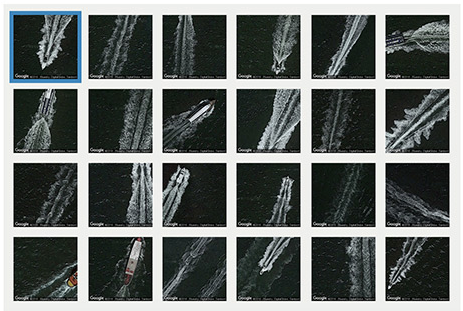
    Terrapattern finds places that look the same using machine learning.

    Terrapattern is a prototype for helping people quickly scan extremely large geographical areas for specific visual features.

    We are particularly keen to help people identify, characterize and track indicators which have not been detected or measured previously, and which have sociological, humanitarian, scientific, or cultural significance.

    Screen Shot 2016-06-06 at 12.20.19 PM

    Terrapattern provides an open-ended interface for visual query-by-example. Simply click an interesting spot on Terrapattern’s map, and it will find other locations that look similar. They say the prototype is ideal for finding things that aren’t usually indicated on maps. For best results, they recommend using a device with a large screen.

    Links


  • Sam, Apple and that Phone

    Sam, Apple and that Phone

    The ” FBI vs Apple ” debate may seem a somewhat esoteric debate to many, but at the very core of this [ no pun intended ] is the basis of free and open societies. No this is not an exaggeration.

    National Security professionals take note. Law-makers take note. Every phone-owner take note.

    Recently, Sam Harris, a commentator I greatly admire for his reasoned and always challenging analysis of major global issues, took the forcefully opposing view in the Apple v FBI debate.

    Whilst very well-reasoned and convincing, I simply could not agree and felt even someone as genuinely erudite as Harris was overlooking the “grammar of the medium” in this pivotal debate. I also felt his risk assessment under-estimated the loss to the individual and the implications for the future of what we understand open societies require to function [free and open communication].

    The nature of digital technology and modern communications makes the “analogue” counter-arguments he was making less relevant in my view. An ethical/moral response to this requires consideration of the paradigm shift that has occurred in the last five years with ubiquitous, personal encryption.  This is the game-changer.

    Given the rise of global threats and the seeming rise of increasingly authoritarian responses [not least that demonstrated in some of the US Presidential debates and even within Australian political debate]  by many otherwise open and/or plural societies, this issue has major and perhaps irreversible long-term consequences for the security and openness of “free/democratic” societies.

    These really are the stakes in my view.

    The #KeepitlockedTim sentiment is simple, but the implications are profound.

    I know Apple agrees. Recently, Apple Vice President for software Engineering, Craig Federighi provided further details on Apple’s view.

    Notably, Zeid Ra’ad Al Hussein, high commissioner for human rights at the United Nations, has warned that a “Pandora’s box” will be opened if Apple co-operates with the FBI.

    Unsurprisingly however, Sam Harris has once again demonstrated how a reasoned and thoughtful individual can entertain opposing views, rationally consider evidence as it changes and refine or even reverse one’s opinions, based on new understandings.

    His most recent podcast, Waking Up with Sam Harris, – Inside the Crucible: Syria and the Islamic State, details [in a short update] his ongoing consideration and analysis of this issue. He references further feedback he has received from a Google engineer and the eloquent and compelling opposition he has to Harris’ position.

    This short reflection by Harris is very worthy of your time. Not because he has aligned with a position I hold, but the way in which he arrives at his reshaped view. This is a genuine intellectual and reasoned-thinker at work.

    You can play the excerpted reflection from the link at the beginning of this post.

    You can listen to the full episode of the Waking Up with Sam Harris podcast here:

    [soundcloud url=”https://api.soundcloud.com/tracks/250503247″ params=”color=ff5500″ width=”100%” height=”166″ iframe=”true” /]

    Interestingly, Harris also references the position of former NSA and CIA Chief, General Michael Hayden [the only person to ever head both organisations], who said in mid-February 2016

    Even when you’re just looking at this through a security lens, that’s actually not the best resolution for American security. Put another way America is more secure — America is more safe — with unbreakable end-to-end encryption,

    Also worthy of note is the position taken by the Chertoff Group,

    We conclude that an extraordinary access requirement is likely to have a negative impact on technological development, the United States’ international standing, and the competitiveness of the U.S. economy and will have adverse long-term effects on the security, privacy, and civil liberties of citizens.


    Compelling.

    #KeepitlockedTim


    Links:

  • Stellerator

    Stellerator

    Innovation

    Five frogs sitting on a log, four decide to jump in, how many are left?

    The answer? Five!  … because deciding and doing are two very different things…


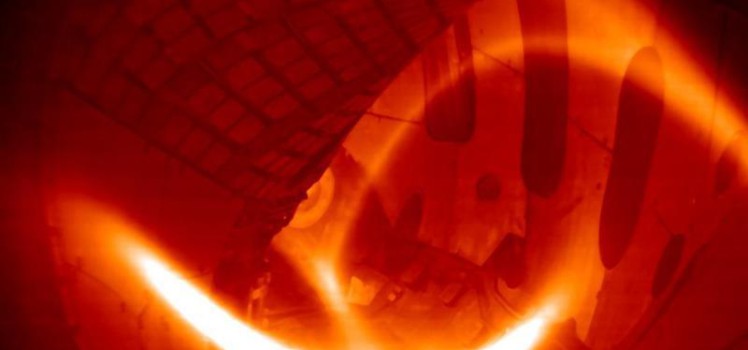
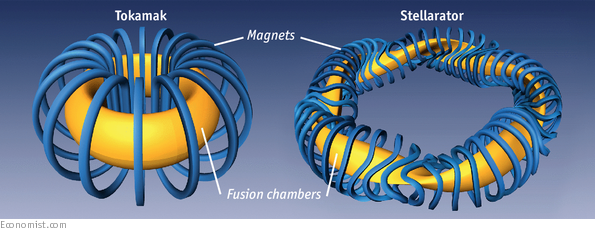
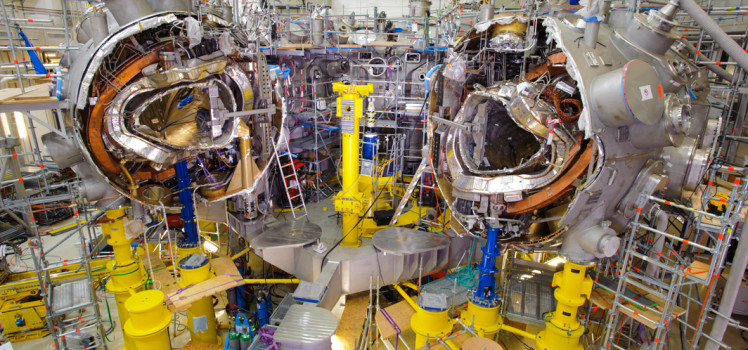
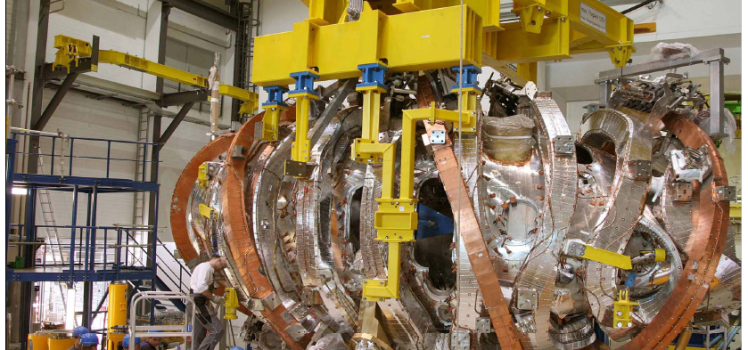
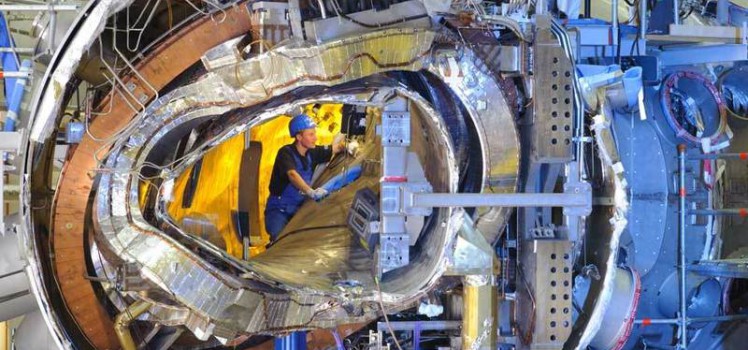
    The Wendelstein 7-X fusion device at Max Planck Institute for Plasma Physics (IPP) in Greifswald produced its first hydrogen plasma on 3 February 2016. This marks the start of scientific operation. Wendelstein 7-X, the world’s largest fusion device of the stellarator type, is to investigate this configuration’s suitability for use in a power plant.

    Angela Merkel, the Chancellor, who is also a doctor of physics, attended the opening ceremony this week.

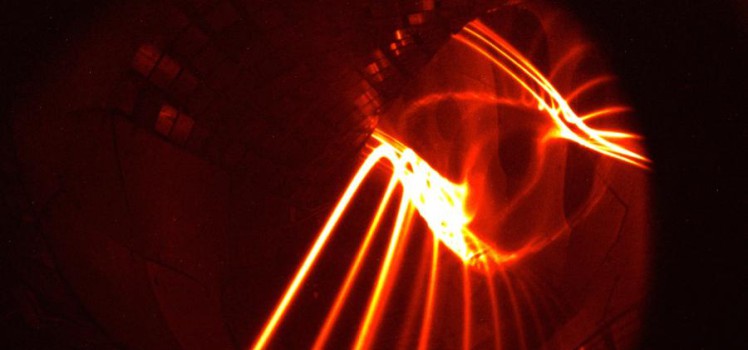
    A 2-megawatt pulse of microwave heating transformed a tiny quantity of hydrogen gas into an extremely hot low-density hydrogen plasma. This entails separation of the electrons from the nuclei of the hydrogen atoms. Confined in the magnetic cage generated by Wendelstein 7-X, the charged particles levitate without making contact with the walls of the plasma chamber.

    “With a temperature of 80 million degrees and a lifetime of a quarter of a second, the device’s first hydrogen plasma has completely lived up to our expectations”,

    states Dr. Hans-Stephan Bosch, whose division is responsible for operation of Wendelstein 7-X.

    The Guardian reports:

    While critics have said the pursuit of nuclear fusion is a waste of money that could be better spent on other projects, Germany has forged ahead in funding the project, which in the past 20 years has cost €1.06bn if staff salaries are included.

    Over the coming years, W7-X, which isn’t designed to produce any energy itself, will test many of the extreme conditions such devices will be subjected to if they are ever to generate power, said John Jelonnek, a physicist at the Karlsruhe Institute of Technology, Germany.

    Links