
Category: Public Health

  • Progress amidst Tragedy

    Max Roser and “Our World in Data” – The Institute for Health Metrics and Evaluation (IHME) estimates that in 1990 more than 12 million children died. Most of these deaths were preventable, and arose from illness and poverty.

    Let’s put this in perspective. Aviation disasters are a form of tragedy that is both relatively uncommon and widely reported. A Boeing 747 can carry up to 620 people. The total number of child deaths in 1990 is equivalent to 53 massive aircraft disasters every day, involving primarily children, with no survivors.

    The number of child deaths declined from over 12 million in 1990 to 5.8 million in 2015 (the year for which we have the latest data). Notably, this decline by 6.3 million child deaths happened despite the absolute number of births increasing slightly over the same period.

    6.3 million fewer deaths means that compared with 1990, there are 17,258 fewer child deaths every single day.

    Links

  • Child Mortality – The good news and the bad news

    Child Mortality – The good news and the bad news

    The good news: child mortality has fallen in every single country over the past few decades. 4 million fewer children died before their fifth birthday in 2015 than in the year 2000.

    The bad news: according to a detailed study published in The Lancet,

    despite remarkable progress in the improvement of child survival between 1990 and 2015, the Millennium Development Goal (MDG) 4 target of a two-thirds reduction of under-5 mortality rate (U5MR) was not achieved globally.

    In other words, more than 60% of the world’s child deaths occur in just 10 countries…


    According to the WEF, the world has made enormous strides in reducing child deaths, cutting the under-five mortality rate by more than half (53%) between 1990 and 2015. But there’s still much more to be done, and this achievement fell short of the Millennium Development Goal target of cutting the under-five mortality rate by two-thirds.

    Estimates suggest that 5.9 million children under five died last year, including 2.7 million newborns. More than 60% of these deaths happened in just 10 countries in Africa and Asia: India, Nigeria, Pakistan, the Democratic Republic of Congo, Ethiopia, China, Angola, Indonesia, Bangladesh and Tanzania.

    Links

  • Water water everywhere and… nope.

    Water water everywhere and… nope.

    Earlier this year, a World Bank report found that water scarcity, exacerbated by climate change, could hinder economic growth, spur migration, and spark conflict. [Ya think?]

    However, most countries can neutralize the adverse impacts of water scarcity by taking action to allocate and use water resources more efficiently.

    Among the findings, key items include:

    • Water scarcity, exacerbated by climate change, could cost some regions up to 6% of their GDP, spur migration, and spark conflict.
    • The combined effects of growing populations, rising incomes, and expanding cities will see demand for water rising exponentially, while supply becomes more erratic and uncertain.
    • Unless action is taken soon, water will become scarce in regions where it is currently abundant – such as Central Africa and East Asia – and scarcity will greatly worsen in regions where water is already in short supply – such as the Middle East and the Sahel in Africa. These regions could see their growth rates decline by as much as 6% of GDP by 2050 due to water-related impacts on agriculture, health, and incomes.
    • Water insecurity could multiply the risk of conflict. Food price spikes caused by droughts can inflame latent conflicts and drive migration. Where economic growth is impacted by rainfall, episodes of droughts and floods have generated waves of migration and spikes in violence within countries.

    The report noted:

    None other than India, the newly anointed growth champion of the world economy, is in the grips of a two-year drought that threatens the economic livelihood of more than 300 million people. Because water levels in India’s 91 reservoirs are at their lowest levels in decades, agricultural output has declined, while electricity generation has plummeted. Dams are parched, factories are operating below capacity, and the lack of safe drinking water has put the health of millions of people at risk. Water wars have erupted between states, making the crisis all that more acute for the national government. Add it all up and the world’s strongest emerging market is being laid low by a climate-induced water crisis.


    Links

  • A useful Drone

    A useful Drone

    On July 27, 2016, Michigan-based Vayu, Inc., in collaboration with the Stony Brook University Global Health Institute completed the first ever series of long-range, fully autonomous drone delivery flights with blood and stool samples, setting records in the process. The samples were flown from villages in rural Madagascar to Stony Brook University’s Centre ValBio, a central testing facility located adjacent to Ranamafana National Park, over hilly terrain without any road infrastructure. The unique ability of Vayu’s delivery drone to take off and land anywhere solves that problem and helps vulnerable rural communities to get the medical care they deserve.

    Links

  • Water Scroller

    Katie Park, the graphics editor at The Washington Post recently published an elegant data visualisation of the impact of the Californian drought on water storage levels.

    California is in the fourth year of its most severe drought on record, facing low precipitation, dwindling mountain snowpack levels and the hottest temperatures in state history. The water supply in the state’s reservoirs has dropped to historic lows, especially in the central part of the state.

    The Water Scroller

    The Water Scroller

    Links

  • Project Tycho

    Project Tycho

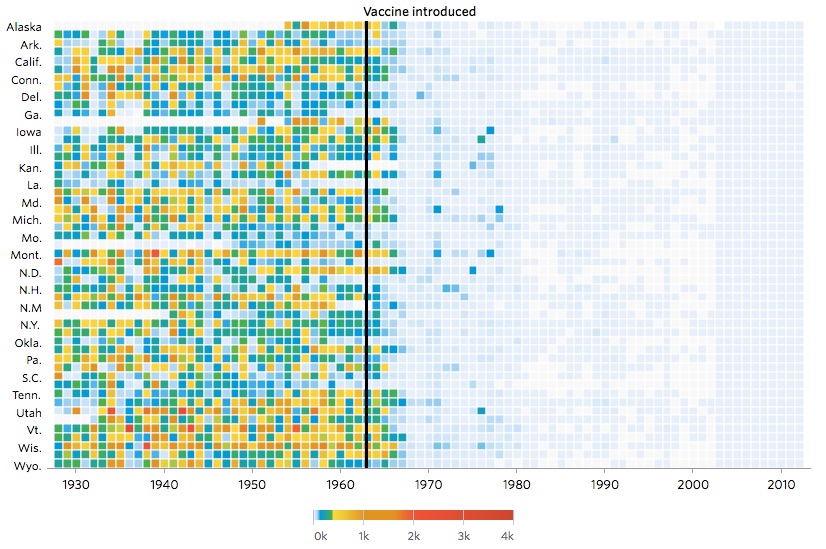
    Project Tycho® is a project at the University of Pittsburgh to advance the availability and use of public health data for science and policy making. Currently, the Project Tycho® database includes data from all weekly notifiable disease reports for the United States dating back to 1888. These data are freely available to anybody interested. Additional U.S. and international data will be released twice yearly.

    The Wall Street Journal [specifically Tynan DeBold @tynandebold  and Dov Friedman @dov_friedman] recently published an outstanding article on Project Tyco, highlighting the Infectious Diseases data sets and the impacts of vaccination on populations over time.

    This was winner of GEN Data Visualisation of the Year 2015. This project documents the impact vaccines had on 7 infectious diseases.

    Look closely.

    Measles

    Impact of Vaccines
    [Source: Project Tycho & Wall Street Journal]

    Hepatitis A

    Impact of Vaccines
    [Source: Project Tycho & Wall Street Journal]

    Links

  • Bill and Polio

  • Renaissance 0 – Middle Ages 1

    Renaissance 0 – Middle Ages 1

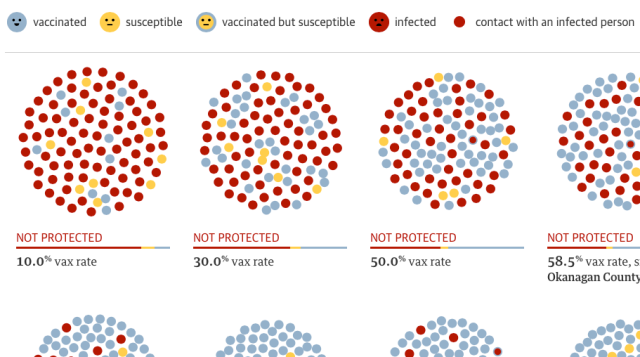
    The vaccination “debate” continues/exists. I checked, it is February 2015. This is the 21st century [by most calendars]

    Another outstanding contribution to the public-health policy debate [sadly] by the Guardian US interactive team of  and 

    The Guardian - Vaccination Simulations
    [Source – The Guardian]
     Reason and the public good appear less a component of modern society than I was aware.

    In response to those that wish to open a “debate” regarding vaccination, I am reminded of the words of one of the 20th century’s greatest philosophers, Lisa Simpson..

    Homer: “Aah, not a bear in sight. The bear patrol must be working like a charm.”

    Lisa: ‘That’s specious reasoning, Dad.”

    Homer: Thank you, honey.”

    Lisa: By your logic, I could claim that this rock keeps tigers away.”

    Homer: Well, how does it work?”

    Lisa: It doesn’t work. It;s just a stupid rock. But I don’t see any tigers around here. Do you?”

    Homer…hmm Lisa, I want to buy your rock!”

    Links:


  • Global Health

    Our new book on GLOBAL HEALTH is out!!
    Is it possible to write a book on the health of all 6.5 billion persons living on the globe? Well we did it and now it is on sale from Monday 27/11 2006.

    We are six authors, but it was Ann Lindstrand who got it together and Birgitta Rubensson that brought it to print. Hundreds of students read and commented various versions.

    http://www.amazon.co.uk/s/ref=nb_ss_b/203-2244500-9311121?url=search-alias%3Dstripbooks&field-keywords=rosling

    We wrote it for those that in a short text want to learn:
    -how the health of the world’s population has changed over time;
    -how the main determinants of health varied with time and place;
    -how health can be measured;
    about the causes of the main diseases in the world;
    -what health care that exist around the world.

    Our book is a summary of the works by greater scholars on global health. The pros with our book are the overviews; the cons are the simplifications and errors that are a consequence of our broad ambitions. – Hans Rosling [Hans Rosling]