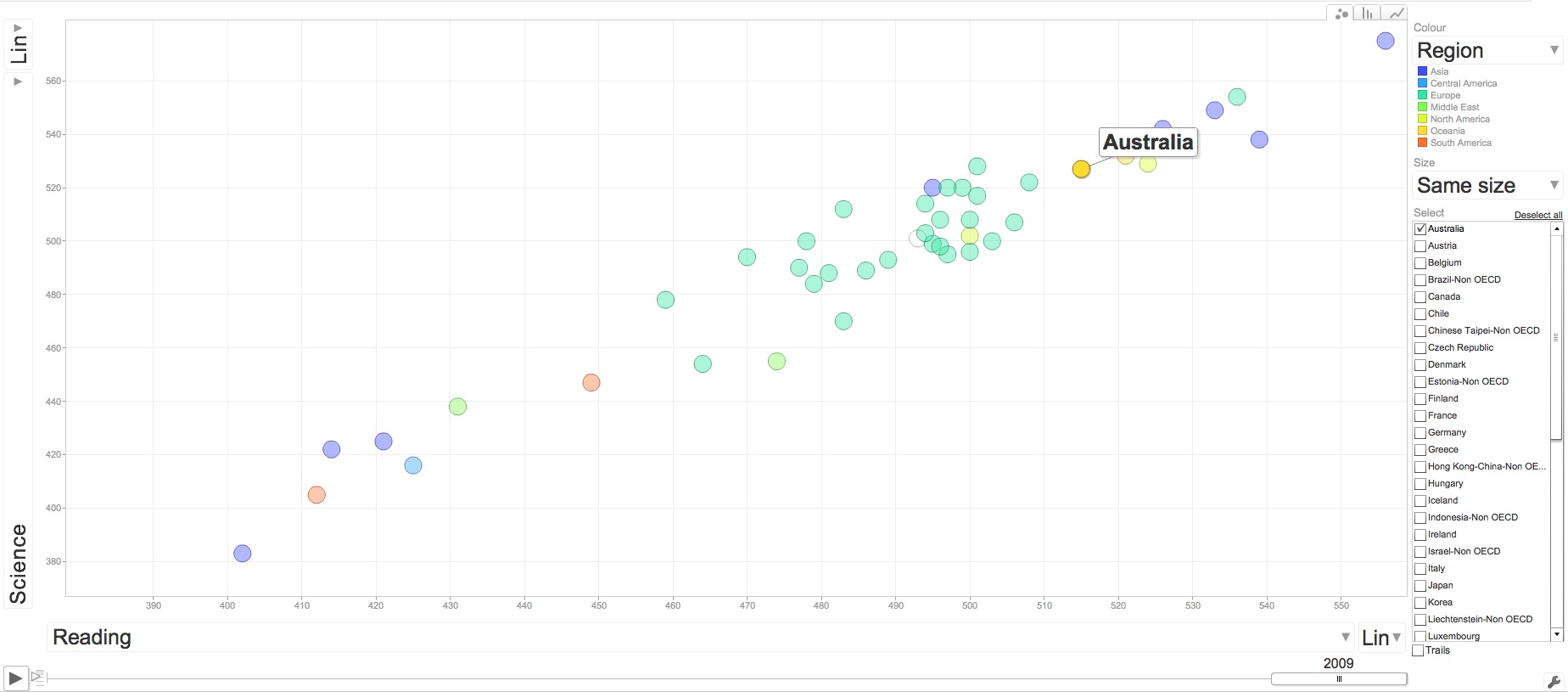
At a time when it appears revealed truths, beliefs and opinions are increasingly privileged in public and political debate,there was always Hans... Vale, Hans Rosling Links The ignorance project GapMinder Tools


At a time when it appears revealed truths, beliefs and opinions are increasingly privileged in public and political debate,there was always Hans... Vale, Hans Rosling Links The ignorance project GapMinder Tools
Mapping the world's immigration flows, by country-by-country. Some notes about Australia: By these estimates, Australia’s net immigration is negative with every country in the world, except for a small positive immigration balance with Sudan. Australia is the only country in the world to have significant positive net immigration with the US. Links Metrocosm.com UN - Total Migrant Stock
The Middle... Once again, Hans Rosling, Professor of International Health at Karolinska Institute and co-founder and chairman of the Gapminder Foundation, reminding us [ with data] just how much development has occurred across the globe in just 200 years. https://youtu.be/_JhD37gSNVU Links BBC2 - This world, Don't Panic - How to End Poverty in 15 Years. GapMinder Global Health 2007…
Confirmation bias, idealogical/doctrinaire policy "imperatives" or good-old special interests are all part of what contributes to our sense of progress in the human condition. Max Roser is a James Martin Fellow researching income inequality and inclusive growth at the Institute for New Economic Thinking, Oxford Martin School. Roser asks the question: Is it actually true that we are building a better…
Designed for Urban Mobility http://youtu.be/1tfYN3lKheo Links: Clean Technica
Aboriginal and Torres Strait Islander People can expect to live up to 10-17 years less than non-Indigenous Australians. The appalling state of Indigenous health has many causes. The mortality rates for Indigenous Australians is on par with some of the world’s most impoverished nations. The United Nations Report, The State of the World’s Indigenous Peoples (2009) indicated Australia and Nepal have the world’s worst…
A fascinating photo-essay in the current The Atlantic, featuring Reuters photographer Carlos Barria's amazing shots, recreating the same framing and perspective as a photograph taken in 1987, showing what a difference 26 years can make in the life of a city. Follow the links to see the full animation on the Reuters website. Links The Atlantic - 26 Years of Growth:…
Australia's population will reach a "projected" twenty three million today, Tuesday 23rd April 2013. 22,999,515 Those working in regional development, government and community understand the strategic challenges and opportunities changes in population and demographics brings. On a personal note, we contributed to this total exactly sixteen years ago today!! [Grin] Notes: This projection is based on the estimated resident population…