

Category: Media

  • All the news, always: Now What?

    All the news, always: Now What?

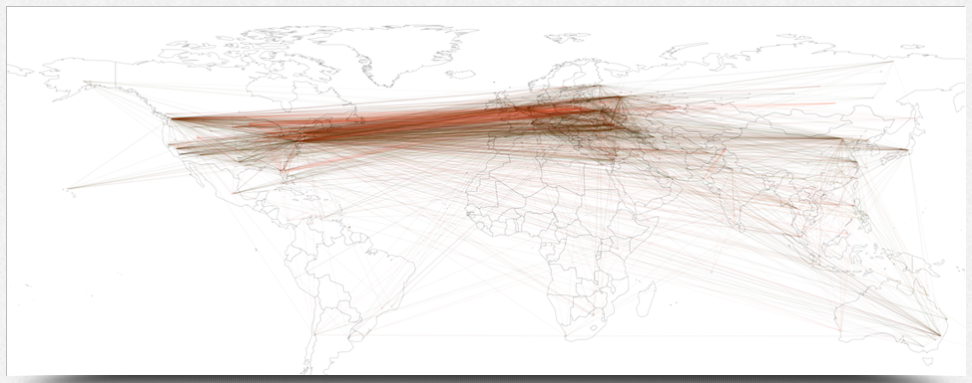
    GDELT is the largest, most comprehensive, and highest resolution open database of human society ever created.

    Yes, REALLY Big!

    GDELT is 100 percent free, with the entire dataset available for immediate download and a set of tools available to work with it.

    Creating a platform that monitors the world’s news media from nearly every corner of every country in print, broadcast, and web formats, in over 100 languages, every moment of every day and that stretches back to January 1, 1979 through present day, with daily updates, required an unprecedented array of technical and methodological innovations, partnerships, and whole new mindsets to bring this all together and make it a reality.

    GDELT Project
    [The GDELT Project]
    Creating a database of a quarter billion georeferenced records covering the entire world over 30 years, coupled with the massive networks that connect all of the people, organizations, locations, themes, and emotions underlying those events, required not only solving unparalleled challenges to create the database, but also a “reimagining” of how we interact and think about societal-scale data.

    Links:

  • Chasing Ice

    On May 28, 2008, Adam LeWinter and Director Jeff Orlowski filmed a historic breakup at the Ilulissat Glacier in Western Greenland. The calving event lasted for 75 minutes and the glacier retreated a full mile across a calving face three miles wide. The height of the ice is about 3,000 feet, 300-400 feet above water and the rest below water.

    Link

  • Data + Design [2]

    Data + Design

    Yes, a repeat from WhaleSongServices, but I think it is worth it.

    I am proud to be a part of the launch of Data + Design @DataDesignBook. A free, open source e-book made by 50+ contributors from around the world!!

    For anyone and everyone that has ever struggled with making data accessible, struggled to use evidence to improve planning or simply grappled with the best way to display an important message to a class, an audience or a colleague; this is the resource for you!

    A new e-book from Infoactive co-founder and CEO Trina Chiasson and Northwestern University Statistical Analyst Dyanna Gregory will take the mystery out of collecting and using data to tell stories using visually engaging tools and techniques.

    The free e-book explains important data concepts in plain language, helping readers learn how to collect, prepare and visualize data through examples that they can relate to, understand, identify with and remember.

    “Data + Design” was created for people looking for a friendly introduction to data — journalists, teachers, nonprofit leaders, business professionals and marketers — who want to improve their ability to identify and collect meaningful data and present it as visually engaging stories.

    More than 50 volunteers [ of which I am one] from 14 countries worked on the e-book, which began during a February write-a-thon supported and sponsored by RJI.

    Read it, use it and share it!

    Links

    About the Donald W. Reynolds Journalism Institute

    The Donald W. Reynolds Journalism Institute works with citizens, journalists and researchers to strengthen democracy through better journalism. RJI seeks out the most exciting new ideas, tests them with real-world experiments, uses social science research to assess their effectiveness and delivers solutions that citizens and journalists can put to use in their own communities.

    About Infoactive

    Infoactive was named Best Bootstrap Company at the 2013 SXSW Accelerator competition. The firm was incubated at Cossette, Canada’s largest marketing agency, and is a graduate of the FounderFuel startup accelerator in Montreal. The platform is now in beta with thousands of active users from more than 130 countries around the globe.

  • The Social Media Economy Explained – By The Onion

    The team at the onion explains the Social Media Economy ;-{) – Worth the 3 minutes!!

    The Onion - Social Media

    Link: Social Media Explained

  • Increasing Specialisation

    Some more wonderful musings by Kevin Kelly on specialisation and the growth of long-tail niches. These trends do have profound impacts for markets, education and most notably, Government policy; in fact the impact is and will be felt in all walks of life.  I hope to write more about this later.

    Evolution moves from the general to the specific. The first version of the cell was a general purpose survival machine. Over time evolution honed that one generality into multiple specialties. In the beginning the domain of life was restricted to warm ponds. But most of the planet was far more extreme; volcanoes and glaciers. Evolution devised cells that specialized in living in boiling hot water, or within freezing ice, or special cells that could eat oil, or trap heavy metals, or glow in the dark. Specialization enabled life to colonize these major, but varied, extreme habitats, and also to fill millions of niche environments – such as the insides of other organisms, or on the dimples of dust particles in the air….

    All the things we make with our mind, and the creations of artificial minds, will all tend over time to become more niche based. The “long-tail” is not merely a characteristic of media, but of technological evolution itself: the tail of niches gets longer and longer. We can imagine the future of almost any invention working today by imagining it evolving into dozens of narrow uses. Technology is born in generality and grows to specificity. Technology wants specialisation.

    Link: Increasing Specialization.

  • Seth’s thinking about quality of communications

    The bandwidth-sync correlation that’s worth thinking about

    Correlation.001
    Check this out. Every once in a while a cool graph pops into my head.

    Here are a dozen or so forms of communication, arranged on two axes.

    On the horizontal, they rank from asynchronous (meaning the creator and the responder are separated in time–like a letter) and synchronous (meaning the creator and the responder are in real time proximity to each other–like a phone call).

    Up and down, I’ve charted the quality of the medium. Quality in terms of density of information exchanged. The 140 characters in Twitter is about as low density as you can get other than a stop light. A movie, on the other hand, is loud and bright and two hours long and there’s audience reaction and it is edited and designed to evoke a response.

    To be clear, then: movies take a long time to make, but they’re high impact. Twitter takes a second to do, but there’s not a lot of info there. One on one coaching is high enough bandwidth that it can change your life and make you cry, in real time, and the Mona Lisa, while less bits per second than a TV show, has enough emotional bandwidth to matter, even if it’s 400 years old.

    So, what can you learn here?

    • There’s a huge correlation between how much interaction there is and how powerful a medium is (at least among successful media). Telephones changed the world because the interaction is so real. As you get more interactive, though, you exchange less dense media. You can’t have a real time conversation online that carries the digital impact of a movie or some other high bandwidth entertainment.


    • The bottom left corner is the scrap heap. It’s hard to place a commercial value on this part of the grid and there’s not a lot of commercially interesting work being done here. People just aren’t interested in low bandwidth, non-interactive media. Graffiti, for example, rarely draws a paying crowd.


    • The top right of the corner is where huge value and difficult sales lie. Not everyone can pay for the scarce resources needed to deliver an in-person seminar or one on one coaching, but those that need and can afford it, love it.


    If you had seen this chart three years ago, you obviously would have invented Twitter. Now that you see it today, what will you create?

    – Seth Godin [Seth’s Blog]

  • Kindle for iPhone

    Amazon Releases Kindle Software for iPhone.

    Glen Fleishmann

    The other shoe has dropped: Amazon late tonight released Kindle for iPhone, a free application that provides access to the catalog of books available for purchase for Amazon’s dedicated hardware device, the Kindle 2. (See “Kindle 2 Improves Design, Not Features,” 2009-02-26, for a review.)

    If you already own or have owned a Kindle books you purchased for that device are automatically shown as available in Kindle for iPhone after you provide your Amazon account name and password. As Amazon has done with media purchases via its Video on Demand service, Kindle books are tied to the account rather than as downloads to a device, as with Apple iTunes purchase.

    Kindle for iPhone doesn’t immediately download all the books you’ve purchased. Instead, they show up in an Archived folder from which you can select which you wish to read on the iPhone.

    You can buy books via Amazon using any Web browser, through the Kindle, or, although Amazon discourages it for reasons of awkwardness, via Safari on the iPhone. Book purchases through any means are available on both Kindle hardware or software.

    The program has the same straightforward and simple approach as the Kindle hardware. You can use a slider to page through the book; an add bookmark button to note the current page; a bookmark button to zoom to particular places in a book or marks you’ve noted; and a text size control.

    Text is quite legible. Unlike the Kindle 2, which force fully justified text across widt seemingly without hyphenation and with strange rivers of white between words at times, the Kindle for iPhone software more sensibly uses flush left justification along with hyphenation, appropriate for a much narrower screen width.


    Amazon uses what it calls Whispersync (a counterpart to its Whispernet download system) to ensure that you find yourself at the same page in the book you left off at if you read among multiple devices. A sync button allows you to make sure that you’ve got the latest page in front of you, too; the software alerts you if your click of the sync button was unnecessary, too.

    The omission of subscriptions to books, magazines, and blogs may be a temporary one, or those absences might avoid issues with Apple about having subscription content pushed to the iPhone as opposed to purchased content.

    Kindle for iPhone is a bit of a game changer. Overnight, 240,000 books are suddenly available for the iPhone through a free application’s conduit. This might also signal that Apple has no plans to enter the electronic book reader market – otherwise, why allow Amazon to set up a beachhead?


    Copyright © 2009 Glenn Fleishman. TidBITS is copyright © 2009 TidBITS Publishing Inc. If you’re reading this article on a Web site other than TidBITS.com, please let us know, because if it was republished without attribution, by a commercial site, or in modified form, it violates our Creative Commons License.

    By glenn@tidbits.com (Glenn Fleishman). [TidBITS: Mac News for the Rest of Us]

  • Why didn’t girls play videogames?

    Why didn’t girls play videogames?.

    At TED in 1998, Brenda Laurel asks: Why are all the top-selling videogames aimed at little boys? She spent two years researching the world of girls (and shares amazing interviews and photos) to create a game that girls would love.

    [Creative Economy : Reports]