
Category: Art

  • Yo-Yo

    Yo-Yo

    Happy Birthday Yo-Yo

  • OneZoom – The Tree of Life

    OneZoom – The Tree of Life

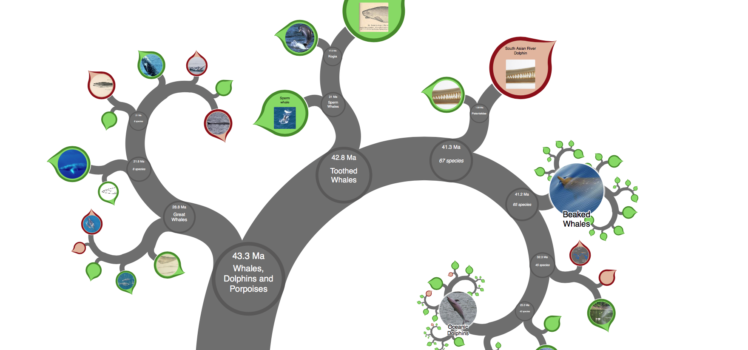
    Think about this for a moment.  Fractal-based mind-map that can contain and visualise all human knowledge.

    The OneZoom software uses fractals to condense the entire tree of life into a single, zoomable page. OneZoom® is so named because all the information is on a single page: all you have to do is zoom to reveal details.

    Not a bad start…

    “Big data” is a growing issue in Science and Industry. Modern computing has enabled large amounts of data to be captured and stored and has revolutionised many branches of science. These advances, however, lead to challenges, such as how to explore and visualise large data sets. The very first blue-skies idea that could have been identified with OneZoom was that of a mind map so vast that it could contain all human knowledge.


    www.onezoom.org

    ONeZoom
    [Source: OneZoom.org]

    You can now sponsor a leaf on the tree for yourself or as a unique gift. Your donations will help the OneZoom charity provide easy access to scientific knowledge about biodiversity and evolution. OneZoom is a registered charity in the UK. Their aim to provide easy access to scientific knowledge about biodiversity and evolution, and raise awareness about the variety of life on earth together with the need to conserve it.

  • Computational Comedy…and the fish have learned

    Neural Networks
    Where is the machine?

    On Technology.

    The reality is that there is a problem, and the fish have learned.

    They have been tracked in the world — but we do something to possible change the next genes between a lot of books that we might never read.

    A computational coding project by Samim. He fed a Recurrent Neural Network with all existing TED Talk Transcripts (1904 speeches or 22.4MB of text which amounts to 4038409 words) and now the model outputs machine generated TED Talks.

    The average ability is that the brain can privately control the world.

    I think there is a message in that for all of us.


    You can watch three speeches – from Jürgen TEDhuber, Ada LoveTED and Isaac TEDimov.

    Read the transcripts here.


    Obama Recurrent Neural Network

    Obama’s highly skilled speech writers have written over 43megabytes or 730895 words of text, not counting interviews and debates.

    All of Obama’s speeches are conveniently readable here.

    Just one example

    Jobs

    SEED: Jobs

    Good afternoon. God bless you.

    The United States will step up to the cost of a new challenges of the American people that will share the fact that we created the problem. They were attacked and so that they have to say that all the task of the final days of war that I will not be able to get this done. The promise of the men and women who were still going to take out the fact that the American people have fought to make sure that they have to be able to protect our part. It was a chance to stand together to completely look for the commitment to borrow from the American people. And the fact is the men and women in uniform and the millions of our country with the law system that we should be a strong stretcks of the forces that we can afford to increase our spirit of the American people and the leadership of our country who are on the Internet of American lives.

    Thank you very much. God bless you, and God bless the United States of America.

    Links

  • WhaleSongs visualised..

    WhaleSongs visualised..

    Thanks to FlowingData for highlighting this link by Albert Cairo to the article by David Rothenberg and  Mike Deal ” Whale Song Explained“.

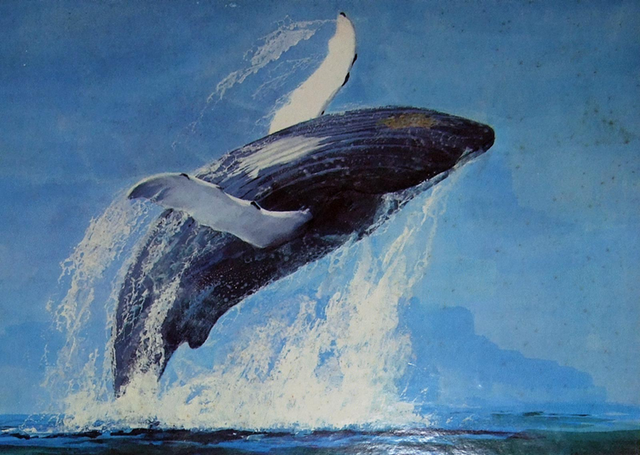
    The largest single pressing of any album of recorded music was not made by Michael Jackson or Mariah Carey, but by an animal the size of a city bus. Ten million copies of Songs of the Humpback Whale were inserted into the January 1979 issue of National Geographic, distributed around the world in 25 languages. The humpback’s cries are credited with inspiring the global movement of conservation measures to protect whales. But what is often overlooked is the true musicality of the sounds. The shrill wails, deep growls, rhythmic scratches, and spectral moans combine into repeating patterns so structured that they fit any conventional definition of music.

    There are eleven populations of humpbacks around the world, each covering their own ocean-sized territory. These populations each boast not only their own dialect of song, but also their own anthem of sorts — each whale singing the same sequence of the same sounds. But week-to-week, month-to-month, and year-to-year this song evolves, as the whales collectively create new phrases and patterns, totally in sync.


    Links

  • My kind of Cartoon

    My kind of cartoon.

    From XKCD (HT: Rocco Weglarz & Robert Wiblin)

    [Andrew Leigh]

  • Google Earth’s Virtual Prado Museum

    Google Earth’s Virtual Prado Museum.

    Madrid’s Prado Museum has long been a destination for art lovers. In the company of the Uffizi Gallery in Florence, the Louvre Museum in France, and the Metropolitan Museum of Art in New York, the Prado is home to countless masterpieces of western art. Unfortunately, the options for viewing its contents have always been either hopping a plane to Madrid, or thumbing through printed reproductions that pale in comparison to the original works. Luckily, there’s now a third option with Google Earth’s Prado Museum feature, which offers ultra high resolution photos of 14 of the museum’s masterpieces.

    While the project isn’t an acceptable substitute for seeing the works in person, it is an exceptional upgrade to the sorts of reproductions to which we’ve become accustomed. The images of the 14 works, which include Velázquez’s Las Meninas, Goya’s The Third of May 1808, Hieronymus Bosch’s The Garden of Earthly Delights, and Fra Angelico’s Annunciation, are 14,000 million pixels in size – that’s 1,400 times larger than an image that could be captured by a standard 10 megapixel camera!

  • Nikon Plans to Stop Making Most Cameras That Use Film

    The Japanese camera maker said Thursday that it would stop making most of its film cameras and lenses in order to focus on digital cameras.

    By MARTIN FACKLER. [NYT > Technology]

    Link: Nikon Plans to Stop Making Most Cameras That Use Film